Currently Browsing: How To
Posted by Managementguru in B-Schools, How To
on Jul 2nd, 2015 | 0 comments
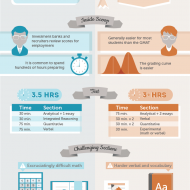
Overall MBA Application #strategy: Average scores are creeping higher every year at the top MBA programs, making it hard to offset a bad GMAT score. Timing and planning are key to reducing the stress of the application process. Since both GMAT and GRE scores are valid for five years, getting the exams out of the way years in advance would free you to focus on all of the other elements of the application. If, like most applicants, you didn’t have the foresight to take the exam right after college, the next best step is to plan your application strategy so that the GMAT is finished before you finalize your list of schools. Your score isn’t everything, but it is an important part of the admissions equation. For whatever MBA admissions round you’re targeting, your target date for taking the GMAT should be at least two months before your first application is due. The deadline for taking the GMAT will vary dramatically depending on the admission procedures of each school to which you apply, and the term in which you are planning to enroll. Keep in mind that you can take the GMAT up to 5 times, but never more than once per calendar month (including a month in which you cancel your score), even if you have cancelled your score. Most applicants devote at least 100 hours to test preparation, and depending on where you are in the process, you may have to take a prep class and perhaps take the test more than once. If this is the case, the first round may not be a realistic option unless you’re able and prepared to completely immerse yourself in the process. A1 Applications usually open in the summer, but start thinking before then. It’s never too early to start planning! How to avoid mistakes in MBA applications? From disorganized resumes to poorly written personal statements, there are a number of mistakes an applicant can make when applying to business school. With some guidance, though, they can avoid these pitfalls and stand out from other prospective students. Many applicants turn to admissions experts for help and advice on which admissions round to enter, how to get strong letters of recommendation and what to say during an admissions interview. “Whether you’re a star candidate or an average one, you can play up your best qualities.” You just need to understand what it is about your background that will make you the best possible candidate – and then prove it clearly in your application and interview. Your resume needs to tell the story of the ‘real’ you – the person behind those #GMAT scores and that work experience. So don’t pretend to be the perfect MBA candidate. For one thing, that person doesn’t even exist. An MBA admissions officer at a leading US business school says the most common error she sees is applicants who are “trying to be someone they are not, and trying to impress the admissions committee.” GMAT scores: Stanford University had the highest average GMAT score for incoming full-time students in fall 2014, according to data submitted to U.S. News. Below are the 10 business schools with the highest average GMAT scores for incoming full-time students in fall 2014. Business school Enrollment (fall 2014) Average GMAT score B-School rank Stanford University (CA) 410 732 1 University of Pennsylvania (Wharton) 859 728 3 Harvard University (MA) 935 726 2 University of Chicago (Booth) 583 724 4 New York University (Stern) 344 721 11 (tie) Yale University (CT) 323 719 13 (tie) University of California—Berkeley (Haas) 241 717 7 Columbia University (NY) 743 716 8 Dartmouth College (Tuck) (NH) 281 716 9 University of...

Posted by Managementguru in Business Management, Entrepreneurship, How To, Organisational behaviour
on May 2nd, 2015 | 0 comments
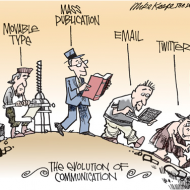
How to effect “Effective Business Communication?” Communication is an entity much talked and debated about in corporate management circles. The question is, have you really understood what the term ‘Communication’ means, how it has evolved over all these years and the impact it creates in an organization? Well, communication is nothing but the transfer or exchange of information from one end to another end, from one user to another user or from sender to receiver to put it straight. Is that it- No! If the process could be as simple as it sounds, there should be no conflicts, no difference of opinions and no mis-understandings in this world. Are we witnessing such a peaceful scenario; In particular, office atmosphere sometimes becomes unbearable thanks to ‘clash of the so called intellectual titans’ fighting over a simple issue which could be solved by discussing it over a cup of good coffee. Now, coming back to the point, the process of communication involves the following steps, Sender- Message- Receiver I’m not quite convinced with this explanation, are you? Let us rewrite it like this, Sender- Message- Medium- Receiver- Interpretation- Feedback This somewhat makes sense because only when the message intended is interpreted rightly so by the receiver or the target, the process of communication gets completed. In olden days when only sign language was the norm of the day, people still communicated precisely through pictograms, cave paintings, ideograms and sign language. This was a form of restricted communication as people had to go to that particular place to see the message. The process of evolution has led us to what we call verbal communication, the highest form of exchanging information. More sophistication has been innovated in the technological sphere and now I’m able to write to you and publish this article from an Apple IPad, of course with references made from the web in a jiffy. Types of communication Three types of communication are present VerbalNon-verbal andWritten. Interpersonal communication is contextual: In other words, communication does not happen in isolation. There is: Psychological, which is your persona and what you bring to the interaction. Your needs, desires, values, personality, etc., all form the psychological context. (“You” here refers to both participants in the interaction.)Relational context, which refers to your reactions to the other person–the “mix.”Situational context deals with the psycho-social “where” you are communicating. An interaction that takes place in a classroom is entirely different from one that takes place in a bar.Environmental context deals with the physical “where” you are communicating. Furniture, location, noise level, temperature, season, time of day, all are examples of factors in the environmental context.Cultural context includes all the learned behaviors and rules that affect the interaction. If you come from a culture (foreign or within your own country) where it is considered rude to make long, direct eye contact, you will out of politeness avoid eye contact. If the other person comes from a culture where long, direct eye contact signals trustworthiness, then we have in the cultural context a basis for misunderstanding. Three Approaches in Communication: Linear approach: Correct communication in this perspective causes the desired effect.Production of exchange and meanings: Communicating through signs and the process of extracting meanings from these messages is called “Signification”. The interpretation can lead to very different but equally valid outcomes.How communication is used to construct our social reality: We constantly share ideas with people around, thereby constructing, re-inforcing or de-constructing our identities. This perspective sees communication as the binding force of any culture, group or society. Source- coursera.com The Semantic Noise: Another important concept in communication is the semantic theory. It is nothing but the noise created in the...
Posted by Managementguru in How To, Intellectual Property Rights, Marketing, Sales, Strategy
on Apr 3rd, 2015 | 0 comments

A brand is more than just a logo or colors—it’s the story you share, the feelings you inspire, and the trust you build. Let’s create a brand identity that truly stands out. Shall we get started? The visible elements of a brand (such as colors, design, logotype, name, symbol) that together identify and distinguish the brand in the consumers’ mind. Investopedia Defines Brand Identity as: How a business wants a brand’s name, communication style, logo and other visual elements to be perceived by consumers. Kapferer’s Brand Identity Prism Model: The brand identity prism by Kapferer describes the brand through six different facets. The identity of a brand describes what makes it stand out and special, as well as the attractiveness of the brand. By the brand’s physique the physical appearance is meant. This includes a prototype of the brand: the product that represents the brand’s qualities. The brand personality connects the brand with human characteristics to differentiate. It is the way a brand speaks to its customers. Every brand tries to build a relationship with its customers. This relationship is more obvious for service brands, but product brands like Porsche and Morgan build relationships with their clients. The question here is what role the brand occupies in the relationship. It could be being a friend or being dominant. The culture of the company is reflected by the values the brand is communicating. Values can be linked for example to the origin of the company and their heritage. The reflection of a brand can be seen as the typical user of the product it is the outward mirror of the brand. It therefore often gets confused with the target market. The self-image is the way customers see themselves when using the brand and how this makes them feel. (Kapferer, 2012) What are the Top 3 Things That Make Customers Loyal to a Brand? Quality – Quality in business, engineering and manufacturing has a pragmatic interpretation as the non-inferiority or superiority of something; it is also defined as fitness for purpose. Qulaity is a perceptual, conditional, and somewhat subjective attribute and may be understood differently by different people. Customer Service – The process of ensuring customer satisfaction with a product or service. Often, customer service takes place while performing a transaction for the customer, such as making a sale or returning an item. Customer service can take the form of an in-person interaction, a phone call, self-service systems, or by other means. Price – For many consumers, price is a very important attribute. The attribute price can indeed be more important on decision making than that of quality, brand name and others. We can conclude that consumer consideration to decide product brand is mainly based on price. The main question is how consumer brand decision is affected by price fluctuations. Does consumer move to another brand as price rises? Branding Gone Bad Pizza Hut Tries to Lose the Pizza For some bizarre reason, Pizza Hut made an attempt to rebrand in 2009 by calling themselves “The Hut.” As a result, the fast-food chain received a significant amount of ridicule from the public, and had to revert back to the original name. Although the company may deny rumors regarding the name change, photographic evidence of the redesigned logo is still circulating online. When British Airways Removed the Union Jack In 1997, British Airways executive Bob Ayling stated, “Perhaps we need to lose some of our old-fashioned Britishness and take on board some of the new British traits.” The company then embarked on a project that saw the Union Jack tail fin flag being replaced with other designs. After receiving numerous complaints from customers, this decision was...
Posted by Managementguru in How To, Organisational behaviour
on Mar 30th, 2015 | 0 comments
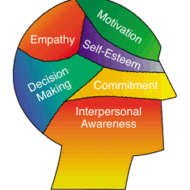
This discussion is centred around an article from WIKIHOW.COM and an infographic from AMERICAN EXPRESS.COM both talking about “Inter Personal Skill Development at workplace via Clear Communication and Body Language.” Inter personal relationship between personnel in workplace has become a serious issue of debate and most of the organizations spend maximum effort and money to make organizational atmosphere bearable devoid of tension and heat. The wikihow article places four important points before us to be considered: Building strong relationshipsDemonstrating ethical behaviorCommunicating clearly andWorking effectively in teams. As Beatrice Vincent rightly puts it “The people with whom you work reflect your own attitude. If you are suspicious, unfriendly and condescending, you will find these unlovely traits echoed all about you. But if you are on your best behavior, you will bring out the best in the persons with whom you are going to spend most of your working hours.” Conflict is the in-thing to be resolved in a work place which is achieved only through motivating the work-force to accomplish some common objectives, that is, the objectives of the organization. How to Develop Interpersonal Skills This infographic stresses the importance of body language like gestures, eye contact, eye rolling, dressing etc. which openly reveals your inner thinking. Explicitly revealing your frutration or unpleasantness over something or someone is definitely not going to help you in getting along with other employees. If your mannerisms do not reflect your self-control, you are in big trouble. Being open and honest may be contextual but being open and rude becomes subjective. 6 Body Language Mistakes to Avoid The most basic of all human needs is the need to understand and be understood. According to Stephen Covey “The Inside-Out approach to personal and interpersonal effectiveness means to start first with self; even more fundamentally, to start with the most inside part of self — with your paradigms, your character, and your motives. The inside-out approach says that private victories precede public victories, that making and keeping promises to ourselves recedes making and keeping promises to others. It says it is futile to put personality ahead of character, to try to improve relationships with others before improving ourselves. So, first understand where you really stand in terms of your EQ or EI (Emotional Intelligence) the vital quality that decides the kind of inter personal relationship you are going to enjoy with your colleagues. Be emphathetic and open minded and never jump to any...
Posted by Managementguru in Change management, Decision Making, How To
on Mar 20th, 2015 | 0 comments

How to find a job you love and do it with passion (not for people who want to become billionaires) a. Self-Discovery: Try to find out what kind of activities you enjoy doing the most and explore if you could turn that hobby or free time activity into a revenue generating source. When you do something with the single aim of earning money or generating profit, an unnecessary pressure comes and sits on your shoulder and presses you down. Follow ManagementGuru Net’s board Interview Prep on Pinterest. For example, if you like music, you could set up a band with like-minded individuals. You may ask how you can even compare the sophistication of a blue collar job with this kind of free-lancing. The issue here is job satisfaction and ultimately the effect of job dis-satisfaction on your health physically or mentally (Of course both are inter-related). If you love gardening, you can always set up a nursery and serve your community. Procure unique saplings and educate the masses on how to keep a small garden. And believe me, people are longing for green atmospheres and there is always scope for you to extend your services into landscaping. Tags: To know the kind of person you are, the kinds of activities you enjoy doing, activities you are doing those are not satisfying to you. b. Personal Identity: The highlight of doing something that you love for a living is that, it reflects your personal identity. Try finding a way to make money doing the things you like to do. Quit doing a job that creates mental and /or physical problems and gauge whether it is directly associated to your job dis-satisfaction. Tags: Personal Identity, Job dissatisfaction. c. Simplify Your Life: Simplify your life so you need less money, allowing you to engage in activities that are satisfying to you, even if they make little or no money. This works out well if you are a single/unmarried person, but when you raise a family it becomes a tough task to make the ends meet and you may start doubting your own abilities to make money. Modern world with all the technological advancements has made man lethargic and technology-dependent. Your son/daughter may not go with your ideas and treat you as an alien if you want to be any different from others. Tags: Simple life, Satisfying work We are able to see a lot of people who work for the IT industry suffering due to their weird work-hours, mental pressure and work-life imbalance. People at one point want to break the hell loose and get out of the monotony. Our education system also plays a big role in shaping the destiny of the future generation. Youngsters must be encouraged to pursue something they are good at and are willing to do. This is all easier said than done. But you will know you have found the right path for yourself when you get up each morning eager to face the day to do the things you like doing and which financially support you. This article is written based on the publication of Prof. Sydney Ross Singer, Medical Anthropologist. To see his posts on academia.edu visit this link...