Currently Browsing: Leadership
Posted by Managementguru in Business Management, Human Resource, Leadership, Organisational behaviour, Principles of Management
on Mar 17th, 2014 | 0 comments
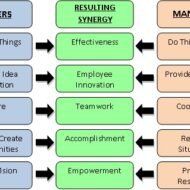
Leader vs. Manager – what is the connecting thread? Who is a Leader? A leader is always looked up to, by his followers as they are truly inspired by his personality, behavior and the power of his words and actions. The intellectual ability of a leader is definitely on the higher scale than a non-leader and also the perceptual ability and decision making skills are amazing. The main idea of pondering over leadership is that how the qualities of a leader make him more successful and how those unique qualities can be acquired by a manager of a firm to influence a group towards achievement of goals. What makes a leader unique? Every individual is bestowed with at least one special quality that makes him unique. A leader obviously is inherent with so many good traits and qualities that influence others and the best part of the story is that he understands his own potential and employs the right skills at the right time. It is basically a personal quality of character in a man that influences the behavior of others in a productive manner. Top 10 qualities of an effective leader; A man of charisma-the followers should be attracted by his magnetism and willingly contribute to the cause Should have a clear idea of future plans-Here he differs from the manager who is concerned more about the productivity Should be action-oriented, dare to achieve the impossible Should be tough at heart -stick to his principles and not a victim to circumstances Should be flexible, when it comes to the #welfare of his people Maintain integrity and humility Value-driven to gather trust Open and honest in his endeavors Creative-the ability to think out of the box Should possess sense of humor that makes him an affable person and even serious issues can be dealt with ease Is Manager a Leader too? Is it necessary that a manger has to be a good leader too? Of course yes. By virtue of being selected for the post of the manger, a person cannot manage the show. Unless he possesses the true qualities of a leader he cannot pull the strings tight and lead the organization in the right track. Without the right elements of leadership, he merely becomes a care-taker enjoying his pay and perks. He will not be liked by his subordinates if he doesn’t have that drive to make a mark of himself as an assertive person and in due course of time either he becomes the entertainer of the firm or he loses his integrity, both of which is not good for the organization’s efficiency and productivity. Roles of an efficient manager: A manager has the necessity to prove himself in terms of planning, formulating strategies, successful completion of targets, increased production, increased sales, acquisition of more orders, managing his team without much conflicts and above all make the team to abide by and obey his rules. A manager to be a successful leader need not be aggressive to prove his point but tough and determined to get things done. Big corporate firms frame ‘systems’ which are nothing but templates of action incorporating all the elements needed for execution in a tailor made fashion. A manager has to now focus on the strategic elements of management since the technicality is being taken care of by the systems. What is the right management approach? Managers expect subordinates to nod their heads in approval to whatever they say. This not the right approach; there should always be a reciprocal relationship between both the parties as in the case of a leader and his followers. A give and take policy makes you more...

Posted by Managementguru in Business Management, Entrepreneurship, Human Resource, Leadership, Principles of Management
on Mar 13th, 2014 | 0 comments
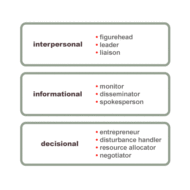
Research on Managerial Roles by Henry Mintzberg and Peter Drucker Henry Mintzberg, the canadian academic observed a few managers and analysed their behaviors and arrived at some conclusions which are listed in the table below. He also identified and attributed ten managerial roles of significance in correlation with the managerial functions. S.NoManagement Functions% of time spent1.Relating to external environment1.82.Planning and setting Objectives19.53.Decision-making6.04.Organising15.05.Leadership and inter-personal role28.46.Communication12.67.Control12.78.Staffing4.1 This table very clearly explains the role of a manager as a leader and the extent of influence he exerts on his sub-ordinates. Proper planning and goal-setting are the key contributors for the successful functioning of a firm. LEADER VS. MANAGER Coming to the managerial roles they can be classified as, 1. Interpersonal roles 2. Informational roles 3. Decisional roles Inter-Personal Roles: Figurehead role– The function is more of a ceremonial nature, like attending the family functions of employees, greeting visitors and a manager performs the symbolic duties of a head of the organization.Leader– He has to plan the HR requirements and motivates the staff to perform well. “Managers are people who do things right; leaders are people who do the right thing.” Remember a manager has to be a leader whereas it is not so in the case of a leader.Liaison– The manager acts as a link between the organization and the external environment to build image and rapport. Informational Roles: Monitor– The manager has to update himself with the current scenario in order to utilize the information for organizing and prompt decision-making.Disseminator– The manager has to communicate and distribute information to his subordinates to effectively accomplish the enterprise objectives.Spokesperson– Efficiently has to communicate the company’s policies to prospective clients and others. Decisional Roles: Entrepreneur– He has to be innovative by adapting to the changes in the environment. He has to be adventurous, persistent and strategic during tough times.Disturbance handler– He has to find appropriate solutions to problemsResource allocator– He has to apportion and allocate resources properly besides delegating authority to the work forceNegotiator– He has to negotiate resources outside and conflicts inside the organization. MANAGERIAL DIMENSIONS Managing: Science or Art? One perspective is Managing, like all other disciplines- whether medicine, music composing or even cricket is an art. It is “know-how.” Still managers can use the organized knowledge about management to perform better. So let us put it this way, Managing as practice is an art; the organized knowledge underlying the practice may be referred to as a science. Let them be complementary to each other and be present in peaceful co-existence. Drucker “ON MANAGERIAL FUNCTIONS ” – A manager has to look after The specific purpose and mission of a firmIncrease productivity by making the employees more productiveConsiderate about social impacts and social responsibilities In his view, the areas a manager has to focus and concentrate are 1. Market standing 2. Innovation 3. Productivity 4. Financial and Physical resources 5. Profitability 6. Manager performance and development 7. Worker performance and attitude 8. Public responsibility He says that business has only two functions- marketing and innovation. While others were concentrating on products and commodities, he concentrated on people and their performance. His “management by objectives- MBO ” became a very popular concept though it faced criticism. MBO according to Drucker is a philosophy that rests on a concept of human action, behaviour and motivation. It sets personal goals (both shortterm and longterm) to be achieved by each individual working for the organization and coverts them into challenges to be accomplished, thus motivating the individuals. The Effective Manager The effective manager is a situational manager who evaluates each approach in the light of circumstances and selects the one that most effectively and efficiently achieve individual...
Posted by Managementguru in Business Management, Entrepreneurship, Human Resource, Leadership, Organisational behaviour, Principles of Management
on Mar 9th, 2014 | 0 comments
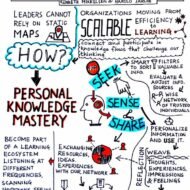
Profile of a successful leader Adaptive Capabilities: Leaders need to radically change their mindset so as to stand the test of time; but the core leadership attributes like vision or creativity, intelligence, commitment, and a healthy dose of luck still continue to define the pre-requisites of success. Integrity of Character is most important when talking about successful leadership. The philosophical undercurrent is that “Be Good, Do Good” and you will be good. The motive must be devoid of mistakes though there is room for mistakes in judgment. Leaders must have a clear vision and be able to communicate this vision to others so that it becomes a shared vision and everybody willingly contributes in fulfilling the vision. Six ‘C’s or six criteria that determine a leader’s credibility Conviction Character Care Courage Composure Competence Cross-Functional Expertise – Acquisition of knowledge should make a leader humble and flexible and gaining knowledge must be seen as a life long experience rather than collection of voluminous data or skills. A leader will try to apply his broad functional knowledge and expertise in the right places and the results will be definitely magnificent. A leader must look into the possible options rather than to plan, the possible rather than the perfect, involvement instead of obedience. Change is the only entity that remains unchanged and it is inevitable for the leaders to consider change as the core element of growth. With accelerated pace of change in the economic, political and socio-cultural environment, leaders not only need to acquire new knowledge and skills but they also need to unlearn many of the things that have out-grown their purposes. Leaders should follow the CODE OF PRIDE to motivate the workforce. P– PROVIDE FOR A POSITIVE WORKING ENVIRONMENT R– RECOGNISE EVERYONE’S EFFORTS I– INVOLVE EVERYONE D– DEVELOP SKILLS AND POTENTIAL E– EVALUATE AND MEASURE CONTINUOUSLY In large corporate organizations, the leader must be willing to share power and control so that leadership is encouraged at various levels. Successful leaders are those who are self-motivated by setting their own standards and compete with themselves. Innovation is the need of the hour What do you mean by innovation? Creating something new or modifying the old one. Here the term innovation implies the change in the “THOUGHT PROCESS” of leaders who are able to turn a crisis into an opportunity. Also called as “THINKING OUT OF THE BOX” where a leader finds new application for old ideas which cannot be discarded or dis-regarded. “You must learn from your past mistakes but not Lea(r)n on your past successes”. High achievers take moderate risks calculating the circumstances and they rely on their own abilities unlike low achievers who invariably like to minimize risks or take wild and irrational risks. Running a corporate business has become more like an experiment since we cannot control or predict the future. It is highly unstable and unpredictable. So leaders have to cope up with this non-linear force acting in the external environment building up pressure. Leaving things as they are can be just as predictable as changing everything, you lose or win both ways. Now let us look at some of the definitions of Leadership 1. “Leadership is generally defined as influencing people so that they will strive willingly towards the achievement of group goals.”- Koontz and O’Donnell 2. “Leadership is the lifting of man’s visions to higher heights, the raising of man’s performance to higher standards, the building of man’s personality beyond its normal limitations.”- Peter F.Drucker 3. “Leadership is the ability to secure desirable actions from a group of followers voluntarily without the use of correction.”- Alford and Beatty 4. “Leadership refers to the quality of the behavior of individuals where by they guide people on their activities in organized efforts.”- Chester I.Bernard Behavioral Commitments of a Leader: Challenging the process Challenging the status quo and act as radical change agents Inspiring others by being pioneers, instigators, navigators and learners Showing risk-taking ability,...
Posted by Managementguru in Business Management, Leadership, Principles of Management
on Mar 5th, 2014 | 0 comments

Management styles vary by company, level of management, and even from person to person. Let us see the different management styles practised in different parts of the world for your better understanding. Elevate your brand’s presence by featuring your post on Managementguru! With over 13 years of trust and expertise, our business blog is the perfect platform for collaboration. Contact us Managerial practices in Asian countries The managerial practices in Asian countries like Japan, China and India are quite different from that of economically advanced countries in the west. Industrial nations are in a position to adopt managerial approaches that suits their mode of operations and nature of labor force. In Asian countries, a paternalistic or participative leadership style is followed while directive style of leadership pattern suits the west. Basically, this difference arises due to the cultural background of people influenced by their tradition. Japanese management East Asian countries like Japan have a set of cultural norms that cannot be overlooked or sacrificed for the sake of business. Their cultural instincts are very strong and they believe in life long employment. Japanese management practice lays emphasis on seniority and shows great concern for each and every employee. The objectives are set by the lower-level employees and it is passed on to the top-level management for approval. These proposals are scrutinized by the supervisors who tactfully suggest the necessary changes, instead of simply accepting or rejecting the proposed objectives. This creates a sense of belonging and the employees identify themselves with the goals of the company. Participative Style You cannot assure that a participative style of decision making always proves beneficial. Sometimes, managers have to show their individualism by taking tough decisions, when the situation warrants for such an action. Here the leader also becomes the firm decision maker. This is quite common in the west, where the leaders identify themselves with the profession rather than the company. Such solo decision making sometimes result in sub-optimal decisions. We are not going to compare and contrast between the various management approaches and which is better. The discussion aims at throwing light on different approaches and styles of management and how it affects the productivity of an organization. Collective Decision Making Japanese management relies on collective decision making (consensus), where the decision making might take time, but it is implemented quickly. The Japanese management is highlighted in this discussion to demonstrate the effectiveness of their approach which is followed by many western nations to ensure success. The novelty is in the fact that they treat people as human beings and not just another factor in production. The communication flows from bottom to top and back. Care is taken to define the problem with clarity before going for a decision. In the west, managers are criticized to come to conclusions even before defining the problem. Bureaucracy Bureaucracy still prevails in most of the Asian countries hindering the progress of business communities. What started as an amazing administrative legacy has now turned authoritarian. Even if the employee knows what the manager says is incorrect; he has to obey the instructions, just because it is issued by his superior. The people are expected to follow the instructions provided and not to question or suggest. Collective Responsibility Collective responsibility and accountability, an informal organizational structure, common organizational culture and competitive spirit makes participative management approach distinct and successful. When the leader acts as a facilitator and not a dictator, naturally the employees will try to give their best shot. Collective responsibility might sometimes lead to ambiguity of decision responsibility. But individual responsibility and accountability vouches for clear and specific decision responsibility. Quality control circle Quality control circle is another feature that distinguishes Japanese management from others. Workshops are organized in a periodic fashion to arrive at solutions for problem...
Posted by Managementguru in Business Management, Human Resource, Leadership, Principles of Management
on Mar 1st, 2014 | 0 comments
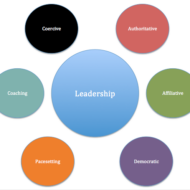
One of the key concepts of leadership is that everyone has innate leadership skills that can be ‘polished’ and developed. In excellent organizations, everyone, regardless of title or position, is encouraged to act like a leader. One of the principles of effective leadership is “to make sure that other people will be willing to follow you. Unfortunately, management education doesn’t place enough emphasis on leadership skills.” The functions of a leader can be defined as follows: 1. Taking the initiative – A leader initiates all actions necessary for the purpose of warranting the health and growth of the enterprise in a competitive economy. 2. He identifies group goals 3. He represents the organization 4. He acts as an arbitrator 5. To assign reasons for his actions 6. To interpret the objectives of organization 7. To guide and direct the organization 8. To encourage team work 9. He manages the organization Top 50 Quotes That Show the Road to Success This exemplary leadership model by kouzes and posner will give you a fair idea on how a leader should set behavioral and performance standards in an organization. Leadership Styles Every leader has his own style that can be defined as a leader‘s behavior towards group members. It refers to the pattern of behavior which a leader embraces in influencing the behavior of his subordinates in the organizational context. Different leadership styles can be categorized as follows. 1. Autocratic Leadership Autocratic leadership is also known as authoritarian, directive, leader centered or monothetic style. Under this style, leader concentrates all authority in himself, instructs a subordinate as to what to do, how to do it, when to do it etc. He also exercises close supervision and control over his subordinates. There are three categories of autocratic leaders a. Strict Autocrat – A strict autocrat believes on negative authority and gives orders which the subordinates must accept. He may also use his powers to disperse rewards to his group. b. Benevolent Autocrat – The benevolent style aids in accomplishing high productivity in many situations and he can develop effective human relationship. His motivational style is usually positive. c. Manipulative Autocrat – A manipulative autocrat leader is one who makes the subordinates feel that they are participating in decision making process even though he has already taken the decisions. 2. Participative Leadership This style is also called as democratic, consultative, group centered or ideographic style. A participative leader is one who consults and welcomes his subordinates to participate in decision making process. Under this style, subordinates are freely allowed to communicate with the leader and also with their fellow subordinates and take their own initiative. 3. Laissez Faire or Free-rein Leadership Under this style of leadership, the leader mostly depends upon the group and its members to establish their own goals and make their own decisions. The leader is passive and assumes the role of just another member in the group. Only very little control is exercised over group members. This style is also known permissive style of leadership. This style is appropriate only in certain situations where the manager can leave a choice to his groups. A leader is supposed to possess these discretionary skills required at different times and during interaction with different people… Qualities of a successful leader The following are the major innate qualities in a successful leader. 1. Physical features like height, weight, health and appearance 2. Intelligence 3. Emotional stability 4. Human relations 5. Empathy 6. Objectivity 7. Motivating skills 8. Technical skills 9. Communicative skills 10. Social...