Posted by Managementguru in How To, Intellectual Property Rights, Marketing, Sales, Strategy
on Apr 3rd, 2015 | 0 comments

A brand is more than just a logo or colors—it’s the story you share, the feelings you inspire, and the trust you build. Let’s create a brand identity that truly stands out. Shall we get started? The visible elements of a brand (such as colors, design, logotype, name, symbol) that together identify and distinguish the brand in the consumers’ mind. Investopedia Defines Brand Identity as: How a business wants a brand’s name, communication style, logo and other visual elements to be perceived by consumers. Kapferer’s Brand Identity Prism Model: The brand identity prism by Kapferer describes the brand through six different facets. The identity of a brand describes what makes it stand out and special, as well as the attractiveness of the brand. By the brand’s physique the physical appearance is meant. This includes a prototype of the brand: the product that represents the brand’s qualities. The brand personality connects the brand with human characteristics to differentiate. It is the way a brand speaks to its customers. Every brand tries to build a relationship with its customers. This relationship is more obvious for service brands, but product brands like Porsche and Morgan build relationships with their clients. The question here is what role the brand occupies in the relationship. It could be being a friend or being dominant. The culture of the company is reflected by the values the brand is communicating. Values can be linked for example to the origin of the company and their heritage. The reflection of a brand can be seen as the typical user of the product it is the outward mirror of the brand. It therefore often gets confused with the target market. The self-image is the way customers see themselves when using the brand and how this makes them feel. (Kapferer, 2012) What are the Top 3 Things That Make Customers Loyal to a Brand? Quality – Quality in business, engineering and manufacturing has a pragmatic interpretation as the non-inferiority or superiority of something; it is also defined as fitness for purpose. Qulaity is a perceptual, conditional, and somewhat subjective attribute and may be understood differently by different people. Customer Service – The process of ensuring customer satisfaction with a product or service. Often, customer service takes place while performing a transaction for the customer, such as making a sale or returning an item. Customer service can take the form of an in-person interaction, a phone call, self-service systems, or by other means. Price – For many consumers, price is a very important attribute. The attribute price can indeed be more important on decision making than that of quality, brand name and others. We can conclude that consumer consideration to decide product brand is mainly based on price. The main question is how consumer brand decision is affected by price fluctuations. Does consumer move to another brand as price rises? Branding Gone Bad Pizza Hut Tries to Lose the Pizza For some bizarre reason, Pizza Hut made an attempt to rebrand in 2009 by calling themselves “The Hut.” As a result, the fast-food chain received a significant amount of ridicule from the public, and had to revert back to the original name. Although the company may deny rumors regarding the name change, photographic evidence of the redesigned logo is still circulating online. When British Airways Removed the Union Jack In 1997, British Airways executive Bob Ayling stated, “Perhaps we need to lose some of our old-fashioned Britishness and take on board some of the new British traits.” The company then embarked on a project that saw the Union Jack tail fin flag being replaced with other designs. After receiving numerous complaints from customers, this decision was...

Posted by Managementguru in Financial Management, Motivation, Video Lecturers
on Mar 17th, 2015 | 0 comments

THE BEST FINANCE DECISIONS EVERY ENTREPRENEUR MUST MAKE Tony Robbins is an American life coach and self-help author. He became well known through his infomercials and self-help books, Unlimited Power, Unleash the Power Within and Awaken the Giant Within. Tony Robbins is a catalyst for change and a strategist for success. He creates change in minutes, when normally it couldn’t be accomplished in years. An Inspiring Quote: “To effectively communicate, we must realize that we are all different in the way we perceive the world and use this understanding as a guide to our communication with others.” Tony Robbins is an entrepreneur, best-selling author, philanthropist and the nation’s #1 Life and Business Strategist. A recognized authority on the psychology of leadership, negotiations and organizational turnaround, he has served as an advisor to leaders around the world for more than 38 years. https://www.tonyrobbins.com/ https://www.youtube.com/tonyrobbinslive https://gumroad.com/l/wqbu...
Posted by Managementguru in Human Resource, Leadership, Motivation
on Mar 17th, 2015 | 0 comments

6 Things a Manager Can Learn From MS Dhoni Leading from the front Staying cool Sharing the due credit with fellow-men Encouraging team members to make them better performers Staying Grounded Resource Utilization No, this article is certainly not about our Indian Cricket team’s captain; but he has a lot to offer to prove my point. Yes, I was contemplating about the various leaders- both in the political and economic sectors and how their attitude and perspective has a direct effect on the followers or sub-ordinates. I thought it would be good to start from M.S.Dhoni, the all powerful leader in his own way standing tall and cool. Don’t miss this powerpoint: The powerpoint given here depicts the different leadership styles pertaining to an organization – be it business, service, non-profit or educational. The motive may differ for each of the listed organizations above but all have to function effectively to reach that ulterior motive. There can’t be a second thought or opinion on this and how the emotional quotient of a leader impacts employee motivation and engagement is something phenomenal. It is directly evident from the functioning style of the employees and their attitude even when you just enter an organization. The impact of leadership styles on employee motivation and performance from Shyama Shankar My Bad Encounter: Recently I had been to a dermatologist for a consultation and even before I could inquire about the doctor’s availability, the girl at the front desk was very particular to know if I would be willing to pay three hundred bucks. I was taken aback to know that the fee was two hundred bucks for visiting during regular hours and three hundred for late hours (It was a sunday and late hours meant visiting the doctor after 12 noon). The hundred rupees did not matter to me at all but the way in which the man has trained his staff to put the patients into an uneasy position made me think – “Where service has to be the motto of his profession, money has REWRITTEN the ETIQUETTES in it own cruel way.” Matched Leadership: How to Use Leadership Styles Effectively Leadership style is one of the most debated topics in management which has influenced a great number of managers and employees. Leadership style extensively influences employee’s commitment and dedication. A participative and democratic kind of leader creates a positive work atmosphere, a coercive leader creates an unbalanced and negative atmosphere; nevertheless all kinds of leaders create a serious impact whether negative or positive. Transformational leaders provide a vision and a sense of mission, inspire pride, and gain respect and trust through charisma, as opposed to a simple exchange and agreement,(Bass et al.1990) whereas Transactional leaders communicate with their subordinates to explain how a task must be done and let them know that there will be rewards for a job done well (Avolio et al.1991). Laissez-faire leadership is a passive kind of leadership style, seen as not caring about other’s issues. There is no relationship exchange between the leader and the followers. It represents a non-transactional kind of leadership style in which necessary decisions are not made, actions are delayed, leadership responsibilities ignored, and authority unused. Now it is time to enjoy some funny quotes on Leadership: Only one man in a thousand is a leader of men — the other 999 follow women. Groucho Marx First rule of leadership: everything is your fault. A Bug’s Life The problem with being a leader is that you’re never sure if you’re being followed or chased. Claire A. Murray The key to being a good manager is keeping the people who hate me away from those who are still...
Posted by Managementguru in Glossary, Strategy
on Mar 5th, 2015 | 0 comments
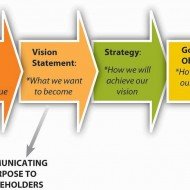
The following is a list of “Key Terms of #Strategic Management” which find their use often when trying to explain the concepts. #Mission An important undertaking that an organization believes it is its duty to do. A specific task or duty assigned to a person or group of people. Missions tend to be long-term and laid out in broad terms, without attempts being made to quantify them precisely. #MISSION STATEMENT Mission statement An open statement of the aims and #objectives of a business or an organization – providing employees with an indication of what they are attempting to achieve through their collective deeds. Mission statements are intended to give substance to the perceived purposes of the organization. Vision Statement A Vision Statement defines what your business will do and why it will exist tomorrow and it has defined #goals to be accomplished by a set date. A Vision Statement takes into account the current status of the organization, and serves to point the direction of where the organization wishes to go. Objective Something which an organization intends to do or achieve; a result that the organization intends to make happen. Long-term or short-term objective, which you hope to achieve within a few years or a few months. Objectives and aims tend to be medium-term and more specific in terms of what is intended to be achieved. SMART OBJECTIVES #Strategy A #plan of future action, usually long-term, in the pursuit of objectives. (e.g.) business strategy; company strategy; financial strategy. The formulation of long-term plans and policies by a firm which inter-connects its various production and marketing activities in order to achieve its business objectives. STRATEGY GENERATION #Aim A result that an organization’s plans or actions are intended to achieve. (e.g.) To try to do something: we aim to be No. 1 in the market in three years’ time. Goal An organization’s aim, objective or purpose. Goals and targets tend to be medium-term or short-term and may be expressed in terms of specific levels of achievements and tend to involve more specific quantification and deadlines. (e.g.) our goal is to break even within twelve months. GOALS VS. OBJECTIVES #Target A level or situation which an organization intends to achieve or aim at. An object or area aimed at the object of an attack or takeover bid. A fixed goal or objective, etc. #Tactics The plans followed to achieve a particular short-term aim. (a) The science and art of disposing and maneuvering forces in combat. (b) The art or skill of employing available means to accomplish an end. (c) A system or mode of procedure TACTICS OR STRATEGY? Plan A set of decisions about how an organization intends to do something, or to ensure that an event or result should happen in the future. Organized way of doing something: contingency plan, government’s economic plans. Plans tend to be quite specific (the shorter-term they are, the more specific they tend to be) and are usually quantified in some detail. They will, in order to ensure that they are complied with, lay out specific deadlines for each key stage. They may also involve the consideration or analysis of priorities and constraints. STRATEGIC PLANNING #Budget A #financial plan, which may be short-term or longer-term, showing probable (planned) #income and #expenditure. Budgets tend to be expressed mainly in monetary terms, although they may focus on the amounts of physical resources (materials, labor time) required. An estimate of income and expenditure for a future period, as opposed to an account, which records financial transactions after the event. BUDGET...
Posted by Managementguru in Business Management, Decision Making, Financial Management, Marketing, Sales, Startups, Strategy
on Mar 4th, 2015 | 0 comments

A popular “Corporate Portfolio Analysis” technique is the result of pioneering effort of General Electric Company along with McKinsey Consultants which is known as the GE NINE CELL MATRIX. GE Nine-Box Matrix This is a strategy tool that offers a systematic approach for the multi business enterprises. It helps them to prioritize their investments among the various business units. It is a framework that evaluates business portfolio and provides further strategic implications. Each business is appraised in terms of two major dimensions – Market Attractiveness and Business Strength. If one of these factors is missing, then the business will not produce desired results. Neither a strong company operating in an unattractive market, nor a weak company operating in an attractive market will do very well. The vertical axis denotes industry attractiveness, which is a weighted composite rating based on eight different factors. They are: Market size and growth rateIndustry profit margins Intensity of Competition Seasonality Product Life Cycle Changes Economies of scale Technology Social, Environmental, Legal and Human Impacts What Does the Horizontal Axis Represent? It indicates business strength or in other words competitive position, which is again a weighted composite rating based on seven factors as listed below: Relative Market ShareProfit margins Ability to compete on price and qualityKnowledge of customer and market Competitive strength and weakness Technological capability Caliber of management The two composite values for industry attractiveness and competitive position are plotted for each strategic business unit (SBU) in a COMPANY’S PORTFOLIO. The PIE chart (circles) denotes the proportional size of the industry and the dark segments denote the company’s respective market share. The green zone suggests you to ‘go ahead’, to grow and build, pushing you through expansion strategies. Businesses in the green zone attract major investment. Red indicates that you have to adopt turnover strategies of divestment and liquidation or rebuilding approach. Advantages Helps to prioritize the limited resources in order to achieve the best returns.The performance of products or business units becomes evident. It’s more sophisticated business portfolio framework than the BCG matrix. Determines the strategic steps the company needs to adopt to improve the performance of its business portfolio. Disadvantages Needs a consultant or an expert to determine industry’s attractiveness and business unit strength as accurately as possible.It is expensive to conduct. It doesn’t take into account the harmony that could exist between two or more business units. PORTER’S FIVE FORCES-INDUSTRY...