Posted by Managementguru in Business Management, Motivation, Organisational behaviour, Principles of Management
on Mar 9th, 2014 | 0 comments

How well employees know about your Organization? Now, this is a million dollar question and a prominent issue that has to be taken care of when it comes to motivating your employees. Transparency is a booster pack that works out wonders in the area of motivation. 25 Great Motivational Quotes to Kickstart Your Life How can a management be transparent in key areas like finance and business deals, my question is WHY NOT? The success of operations of a firm relies solely upon the performance of individuals who work towards the accomplishment of goals. They are the key persons who should be kept abreast about the activities of the firm. What makes some organizations stand out? When the Boss wants each and every employee to be truthful and loyal to him, the same expectancy would be there on the part of the workforce –Why don’t the bosses understand this? Integrated Organizational Development I would cite TVS Group as a classic example that commands respect from the employees and many a times I’ve heard people say that they are proud to work for TVS. What makes the employees so motivated to work for certain firms overlooking the pay scale and perks? One should deeply delve into the psychological theories that support motivation, perception and attitude. Etiquette of the company: This is one thing that a firm has to clearly communicate to its work force. The ideology and principle behind the running of the business should be genuine and authentic. The pathway to achieve those missions should be realistic and achievable-to put it clearly a firm should have its business roots stemming out from clear cut intent and purpose. When JRD Tata wanted to start a steel plant in India, not many believed it to be a possible venture. The business legend had clear cut intent of installing a steel plant to utilize the resources available in India and to pass on the proceeds for the economic benefit of the country. Nobody suspected his intent; such was his determination and resolve. This infographic beautifully portraits the scenario of how the future employees would be: Communication of Goals: The management will have clear plans of production target which has to be communicated properly to the lowest level with the same amount of clarity. This has to be done via channels or different levels of management and executives have to play their roles properly. Nobody needs to show their prowess or power; only thing needed is proper delegation of authority and responsibility. This gives clear direction to the work force and when their immediate boss sits with them for periodic discussions to decide on the short term as well as long term objectives, they feel part of the show which immensely motivates them. Ethical Standards of the company: This again adds image to the company and “As is the Leader so is the Employee.” The management should not involve itself in any kind of lobbying – When there is political corruption, malpractices become the order of the day. What Kind of a Leader Are You? A country like India needs more educated leaders who can bring awareness on the importance of economic independence and even distribution of wealth to the masses. If people clearly know what is right and what is wrong, the unwanted elements cannot take them for a ride. Given the population, India though marching towards becoming a developed nation, the growth is hindered by poor policy decisions and sky rocketing inflation. Clarity in Structure: Ego clashes start when the organizations have more number of levels and generate chaos in communication. Misunderstanding creeps in because there...

Posted by Managementguru in Business Management, Entrepreneurship, Human Resource, Leadership, Organisational behaviour, Principles of Management
on Mar 9th, 2014 | 0 comments
Profile of a successful leader Adaptive Capabilities: Leaders need to radically change their mindset so as to stand the test of time; but the core leadership attributes like vision or creativity, intelligence, commitment, and a healthy dose of luck still continue to define the pre-requisites of success. Integrity of Character is most important when talking about successful leadership. The philosophical undercurrent is that “Be Good, Do Good” and you will be good. The motive must be devoid of mistakes though there is room for mistakes in judgment. Leaders must have a clear vision and be able to communicate this vision to others so that it becomes a shared vision and everybody willingly contributes in fulfilling the vision. Six ‘C’s or six criteria that determine a leader’s credibility Conviction Character Care Courage Composure Competence Cross-Functional Expertise – Acquisition of knowledge should make a leader humble and flexible and gaining knowledge must be seen as a life long experience rather than collection of voluminous data or skills. A leader will try to apply his broad functional knowledge and expertise in the right places and the results will be definitely magnificent. A leader must look into the possible options rather than to plan, the possible rather than the perfect, involvement instead of obedience. Change is the only entity that remains unchanged and it is inevitable for the leaders to consider change as the core element of growth. With accelerated pace of change in the economic, political and socio-cultural environment, leaders not only need to acquire new knowledge and skills but they also need to unlearn many of the things that have out-grown their purposes. Leaders should follow the CODE OF PRIDE to motivate the workforce. P– PROVIDE FOR A POSITIVE WORKING ENVIRONMENT R– RECOGNISE EVERYONE’S EFFORTS I– INVOLVE EVERYONE D– DEVELOP SKILLS AND POTENTIAL E– EVALUATE AND MEASURE CONTINUOUSLY In large corporate organizations, the leader must be willing to share power and control so that leadership is encouraged at various levels. Successful leaders are those who are self-motivated by setting their own standards and compete with themselves. Innovation is the need of the hour What do you mean by innovation? Creating something new or modifying the old one. Here the term innovation implies the change in the “THOUGHT PROCESS” of leaders who are able to turn a crisis into an opportunity. Also called as “THINKING OUT OF THE BOX” where a leader finds new application for old ideas which cannot be discarded or dis-regarded. “You must learn from your past mistakes but not Lea(r)n on your past successes”. High achievers take moderate risks calculating the circumstances and they rely on their own abilities unlike low achievers who invariably like to minimize risks or take wild and irrational risks. Running a corporate business has become more like an experiment since we cannot control or predict the future. It is highly unstable and unpredictable. So leaders have to cope up with this non-linear force acting in the external environment building up pressure. Leaving things as they are can be just as predictable as changing everything, you lose or win both ways. Now let us look at some of the definitions of Leadership 1. “Leadership is generally defined as influencing people so that they will strive willingly towards the achievement of group goals.”- Koontz and O’Donnell 2. “Leadership is the lifting of man’s visions to higher heights, the raising of man’s performance to higher standards, the building of man’s personality beyond its normal limitations.”- Peter F.Drucker 3. “Leadership is the ability to secure desirable actions from a group of followers voluntarily without the use of correction.”- Alford and Beatty 4. “Leadership refers to the quality of the behavior of individuals where by they guide people on their activities in organized efforts.”- Chester I.Bernard Behavioral Commitments of a Leader: Challenging the process Challenging the status quo and act as radical change agents Inspiring others by being pioneers, instigators, navigators and learners Showing risk-taking ability,...
Posted by Managementguru in Decision Making, Principles of Management, Project Management
on Mar 7th, 2014 | 0 comments

Fundamental Aspect of a Project Planning is the fundamental aspect of any management system as it sets the direction or pathway, which the firm has to follow in order to accomplish the goals and objectives of an organization. In a project management or a process management, planning is the key function followed by preparation of a proposal or a report that analyses and defines the resources necessary to carry on the project. This project report can then be sent for evaluation by an expert consultant to determine the feasibility and viability of the project. Organising to Get the Desired Result A project undertaken has to be meticulously planned and organized to achieve the desired result in the given time frame. One has to understand that a project differs from a process in that, it involves fixed time fame and cost frame. Say,for instance, your firm is rewarded with a project to design ERP solutions for a big corporate company. What will be step one? You will try to gather all the details regarding organization structure and hierarchy, people involved and their designations, availability of physical resources, whether the corporate firm is technically equipped, product portfolio, strategic business units and their viability, distribution channels and so on., As one is aware, enterprise resource solution software integrates production, marketing and human resource departments to facilitate even flow of information and quick execution of orders without any time delay. Picture Courtesy: Project Management and Leadership Champions Data Collection Data collection is inevitable and has to be precise to attain your set goals. The next logical step will be deciding the time frame and allocating resources (human and other physical resources) to carry on the project. If you feel that the delivery deadline cannot be met with, you have to immediately inform your sponsors about the time delay and extend your time frame for the project to materialize. On -Time Delivery Projects that involve production and delivery of goods depend on the manufacturing cycle time and delivery lead time. Implementation becomes a cake walk if your business plan has incorporated, 1) well laid down step by step procedures, 2) leverage for uncertainty in the external environment and 3) focus on proper communication. Communicating the entire project plan as per the intentions to the people concerned is very vital for the success of a project, because people should understand, what needs to be done, what is one’s role, and the strategies evolved by the management. PERT and CPM Program evaluation and review techniques (PERT) and critical pathway method are some of the tools that help in ascertaining the progress rate of projects. These tools help in identifying specific milestones and activities that are to be carried out in a sequential manner and also to estimate the time required for each activity, with a help of a network diagram. A very interesting and simple video explaining how to determine project duration using critical path…. Success of a project management is determined by Decision making ability Communication skills Negotiation techniques and Time management skills, of the project manager and also depends on how well it protects the interests of the stakeholders involved. A project is a comprehensive team effort with the budget and time well within the scope of the...
Posted by Managementguru in Business Management, Labor Management, Organisational behaviour
on Mar 7th, 2014 | 0 comments

People Management and Trade Unions Need for Trade Unions Why do employees join trade unions is an important question. Most of the workers are members of any one of the trade unions. One of the major objectives of trade unionism is to promote industrial democracy. This objective is achieved when trade union is an organization of the workers, for the workers and by the workers”. In practice this rarely happens and instead unions become an oligarchy. Union leaders by and large, show authoritative behavior with less participation, openness and transparency. Decision-making is centralized, elections are often postponed and positions are filled repeatedly by nominations. Rank and file is pampered with promises and seldom gets near to decision-making process. Positions get worse when unions are guided by outside leaders and regulated by the policies of political parties. Ideology of Trade Unions Absence of democratic leadership reduces the effectiveness of trade unions and prevents the development of trade union leadership from among the workers within the industries. In due course, trade unions become obsessed with political ideology or personal interest ousting the welfare of the workers. Before we move on to the functions of trade unions, let us understand the reasons for the existence of such organizations. To get a common platform to air ones views, aims, ideas and feelings and obtain recognition and status among fellow workers. Make use of the principle of unity for the purpose of securing good working conditions, higher economic compensations, better career prospects and welfare needs. Security of employment and protection against calamity of accident, death and social security after retirement. Restrict management action which is against the interest of the workers. Functions of a Trade Union The internal functions of a labor union includes better wage claim, to ensure better working conditions, reasonable work etc.,The external functions include conducting night school, games, sports and other recreational activities. These two functions may be grouped as economic and social functions. Many unions try to capture political power through election, so that they can influence upon the programmes and policies of government in favor of labor. This function is known as political function. Under the legal functions, the interpretation of law takes the major share. A jist of the main purpose of trade organizations: To improve the standard of living and working condition of the workers. To protect the security of workers’ employment. To ensure better health, reasonable working hours and welfare measures. To improve the political status. To raise the vocational status. To bring better participation in the management. To inculcate the feeling of self respect and confidence among worker force. To bring industrial peace and harmony. As long as unionism is considered as an anathema by the management, there will be lack of harmony and mutual trust between the management and labor force. Management must not consider labor unions as a legal obligation as it does not develop faith and goodwill. Instead the union has to be viewed as a partner in trade to live with and work with. Union must also recognize that work is worship and the survival and success of organization depends on the very survival and success of the workforce. Once the team spirit is built up no unreasonable demands will be raised and union leaders must view strikes and lock outs as last resorts to put pressure on management. The Trade Unions Act, 1926– An act to provide for the registration of Trade Unions and in certain respects to define the law relating to registered Trade...
Posted by Managementguru in Business Management, Principles of Management, Training & Development
on Mar 7th, 2014 | 0 comments
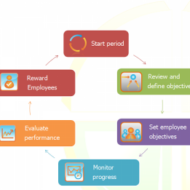
MBO BY PETER DRUCKER Peter Ferdinand Drucker was an influential writer, management consultant, and self-described “social ecologist. Harvard Business Review honored Drucker in the June 2004 with his seventh McKinsey Award for his article, “What Makes an Effective Executive”, the most awarded to one person. The Concept of MBO: Management by objectives was a concept introduced by the doyen of management, Peter Drucker. This concept involves formulation of objectives for the entire organization and which are then broken down into divisional, departmental and finally individual objectives. Objectives are decided on the basis of mutual consultation between managers and employees at the departmental and divisional levels and thus it can be appropriately called an integration of top down and bottom up approaches in management. The specific aim is to make the employees participate in decision making and thus motivate them to perform better. Management by objectives follows a step-by-step procedure that ensures the feasibility of the action plans decided upon. Realistic and achievable plans are set. Activities to be preformed are identified. Logical relationship between the sequences of activities is laid down. Time frame and cost frame are fixed. Resources to be allocated are decided upon. Salient features of the process: Self control and Self direction: The workers exhibit keen self control in that, they self appraise their performance that results in intrinsic motivation. Setting short goals and periodical review to match the current performance with the expected standards greatly boosts the performance of each and every individual and gives him the necessary drive to accomplish the assigned tasks. Periodic progress review: This helps to correct errors and deviations if any. This review is done by managers of higher levels in a constructive way and adequate counseling and guidance can be given to the subordinates to bridge the shortfall if any, in performance. This is possible only when there exists a mutual understanding between the superior and subordinates to find reasons and solve problems together. Reviews need not necessarily pinpoint errors but also revise future plans and actions. The major emphasis of management by objectives lies in its result oriented approach. What is the relationship between management by objectives and motivation? Motivation of an employee can be brought about by financial incentives such as bonus, increments, pay and perks or non-financial incentives such as recognition, appreciation and additional responsibilities. But nothing can equal self-motivation which makes an employee perform with aplomb. As management by objectives is directly linked with goal-setting, performance becomes better and better as the goals are set at a higher level. It involves complete participation from the employees’ end and when specific goals are set by mutual consent of workers and management, the results are magnificent. Many firms practice management by objectives to promote harmony and sense of belonging in the minds of employees as a result of which there is remarkable improvement in performance and productivity. The focus is on improving the job design and work module to make the jobs more meaningful, interesting and...