Posted by Managementguru in Business Management, Human Resource, Labor Management, Organisational behaviour, Principles of Management, Strategy
on Mar 18th, 2014 | 0 comments
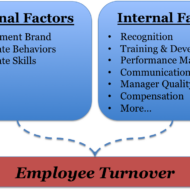
Smart Retention Strategies: Before going into the details of how to handle attrition, the first thing you must understand and realize is this. Each person working for you will have different expectations, perspectives and demands about his job, work environment and compensation respectively. Right at the time of recruiting and selecting the employee, his ideas must be taken into consideration and then it becomes the prerogative of the management whether to hire the person for that particular job. So the first step will be the right person for the right job, giving due importance to the anticipation of the employee who is going to become a member of your business family. Udemy Best Sellers:New Manager Training in Essential SkillsLeadership: Practical Leadership Skills Need for Open Conversation: In case of a small firm or company, it is easy for the manager to have a one on one conversation with each employee to settle his score of grievances then and there. Managers must have an open conversation without room for any ambiguity in the minds of his workers. The manager should try to protect the interest of the employees by representing their demands to the management at the right time. Many employees quit their positions because they have a nagging feeling at the back of their minds that their immediate boss is not the right kind of person to whom they can look up to and ask for support. In big corporates it is not easy to go for a one on one approach. A unique corporate culture that Trains the employees to have an uniform approach to all the systems of routineLed by an effective leader who controls and monitors the behavior and attitude of the workersPossesses sound management practices that make the employees come out with their suggestions freely and induce them to participateProvides satisfactory compensationIncorporates an open door policy catering to the different needs of people and also to the different levels of management, will help the managers to have a healthy relationship with the employees. Human Wants and Needs: Human wants are unlimited and when one want is satisfied, we want more of the same or yet another of a higher order. Approach your workforce to satisfy their craving either in terms of compensation or recognition which will also help to retain your workforce to a greater extent. There should be room for growth, especially for entrepreneurial minds and minds that have parallel thinking. Pic Courtesy: CuteHR Self-Motivation is the Key: Although motivation brings cheer amongst your workforce, self-motivated employees produce better results. Job satisfaction is a relative term; it differs with individuals, some like challenges and some are easily satisfied with an increase in salary quotient. A comprehensive appraisal on the personality of your workforce will give you a clear picture of the IQ (Intelligence Quotient) and EI (Emotional Intelligence) range of your employees which helps in designating employees in the appropriate slots. Such human rationing saves you a lot of time, energy and money as the employees are guaranteed satisfaction in their jobs. Contracts and Agreements: Contracts and agreements bind the employees to the firm only legally. How is that going to help you in terms of productivity? If one of your employees is going to work with discontent, he becomes a problem source spreading the same kind of feeling to others working with him. So it is also necessary for the management to spot out these problem persons either to bring them back into the groove or fire them without any further delay. Rising costs of living and unemployment ratios are really of economic concern, but still we find employees just like that quitting...

Posted by Managementguru in Business Management, Human Resource, Organisational behaviour, Principles of Management
on Mar 17th, 2014 | 0 comments
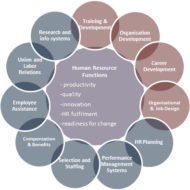
Personnel or Human Resource Management: is the strategic approach to the management of an organization’s most valued assets – the people. Human resource is always in great demand as competent or skilled labor is in short supply. It is important to remember that no one is born with the value of excellence, as the acquisition is gradual in nature and only possible through proper training and one’s own cognitive perception. It is not that people have to belong to the elite group to make their mark in the respective fields. The best leaders and managers often are ordinary people creating amazing results and astounding success. Try some of these golden etiquettes for achieving excellence in the management of human resource: Clear objectives have to be set with the consensus of the employees Recognize the progress Confront problems Manage with flexibility Understand the value of quality Manage time for better results Enhance decision-making skills by delegating authority Master stress Motivate people Think like a winner Pursue a participative style of leadership To achieve the goals of the organization, the HR department will have to reorient itself on the following lines. It is very important that ‘Right people are chosen for the Right job’. During the induction stage, employee attitudes must be shaped in harmony with the culture of the organization. Dynamic training system should be introduced which is supposed to be a continuous process rather than a sporadic exercise. Quality of Work Life: Organization should ensure satisfactory quality of work life in order to minimize the sense of alienation, found in the workplace. It should contribute to an atmosphere to improve self-discipline, self-motivation and self realization for the purpose of production optimization in terms of both quantity and quality. The presence of a fair performance appraisal system will facilitate the growth prospects of employees in terms of career advancement and development. Fair Compensation: Institutions must work out a fair compensation package for all categories of workmen so that they may be able to receive the living wages instead of subsistence-level wages. The accent should be on production and productivity, without any compromise. Opportunities are aplenty, particularly for experienced personnel as the industries offer wide job prospects for the prospective candidates. Now-a-days job hopping is rampant which is a serious issue to be managed. A number of organizations offer bonus in the form of stock that interjects a feeling of oneness, which ensures alignment of interest between employees and the management. Favored position in terms of enhanced performance from the work force is possible only if the management comes down to embrace and lend their ears to certain rational demands form the other end. Security of Employment Increased wages Employee ownership Participation and employment Internal promotions Information sharing Incentives etc., The personnel function can 1) Attract attention to indicate the importance attached to management’s process and the various policies, practices and systems that support the process. 2) Provide necessary information and expertise on best practices in rival companies to benchmark the process and provide with analytical support for diagnosing and recounting solutions to problems arising in the employee management relation. 3) Engage in business decisions and accelerate change that is consistent with the underlying values of the company. Note: The laws and matters relating to wages and bonus come under the purview of the Ministry of Labor and Employment. The Minimum Wages Bill was passed by the Indian Dominion Legislature and came into force on 15th March,...
Posted by Managementguru in Business Management, Human Resource, Leadership, Organisational behaviour, Principles of Management
on Mar 17th, 2014 | 0 comments
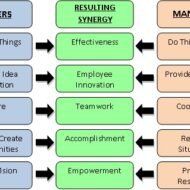
Leader vs. Manager – what is the connecting thread? Who is a Leader? A leader is always looked up to, by his followers as they are truly inspired by his personality, behavior and the power of his words and actions. The intellectual ability of a leader is definitely on the higher scale than a non-leader and also the perceptual ability and decision making skills are amazing. The main idea of pondering over leadership is that how the qualities of a leader make him more successful and how those unique qualities can be acquired by a manager of a firm to influence a group towards achievement of goals. What makes a leader unique? Every individual is bestowed with at least one special quality that makes him unique. A leader obviously is inherent with so many good traits and qualities that influence others and the best part of the story is that he understands his own potential and employs the right skills at the right time. It is basically a personal quality of character in a man that influences the behavior of others in a productive manner. Top 10 qualities of an effective leader; A man of charisma-the followers should be attracted by his magnetism and willingly contribute to the cause Should have a clear idea of future plans-Here he differs from the manager who is concerned more about the productivity Should be action-oriented, dare to achieve the impossible Should be tough at heart -stick to his principles and not a victim to circumstances Should be flexible, when it comes to the #welfare of his people Maintain integrity and humility Value-driven to gather trust Open and honest in his endeavors Creative-the ability to think out of the box Should possess sense of humor that makes him an affable person and even serious issues can be dealt with ease Is Manager a Leader too? Is it necessary that a manger has to be a good leader too? Of course yes. By virtue of being selected for the post of the manger, a person cannot manage the show. Unless he possesses the true qualities of a leader he cannot pull the strings tight and lead the organization in the right track. Without the right elements of leadership, he merely becomes a care-taker enjoying his pay and perks. He will not be liked by his subordinates if he doesn’t have that drive to make a mark of himself as an assertive person and in due course of time either he becomes the entertainer of the firm or he loses his integrity, both of which is not good for the organization’s efficiency and productivity. Roles of an efficient manager: A manager has the necessity to prove himself in terms of planning, formulating strategies, successful completion of targets, increased production, increased sales, acquisition of more orders, managing his team without much conflicts and above all make the team to abide by and obey his rules. A manager to be a successful leader need not be aggressive to prove his point but tough and determined to get things done. Big corporate firms frame ‘systems’ which are nothing but templates of action incorporating all the elements needed for execution in a tailor made fashion. A manager has to now focus on the strategic elements of management since the technicality is being taken care of by the systems. What is the right management approach? Managers expect subordinates to nod their heads in approval to whatever they say. This not the right approach; there should always be a reciprocal relationship between both the parties as in the case of a leader and his followers. A give and take policy makes you more...
Posted by Managementguru in Business Management, Marketing, Principles of Management, Strategy
on Mar 16th, 2014 | 0 comments
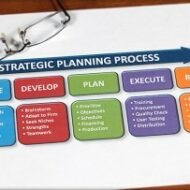
Strategies to Tide Over Competition Distinctive Competence: is nothing but a set of unique capabilities that certain firms possess allowing them to make inroads into preferred markets and to gain advantage over the competition. Human brain is the greatest think tank and it evolves new methodologies of business management from time to time in order to sustain as well as win the race. Planning is the key factor that decides the rise or downfall of a business empire. “Where we are?” and “Where we want to be in the next few years?” is how every business leader’s basic thought process must be, without which he cannot proceed further in the competitive corporate environment. If we call planning as the basement of a building, then it should be very precise, clear cut and robust so that the business empire built on this basement will never collapse and it will also serve as a role-model for everyone who aspires to set his foot in the corporate business world. At the corporate level, strategic planning helps to establish the Purpose Mission and Objective for the firm as a whole and “outlines the overall plan to attain them.” Strategy is nothing but a unique set of action plan that will distinguish you from your competitors and make you have an edge over them. Likewise strategic planning is nothing but thinking out of the box to” CREATE YOUR OWN NICHE MARKET” in the business environment. STRATEGIC COMPETENCE takes you to the top of the ladder; but to withhold your position you need to formulate innovative ideas to tide over the challenges in the market. Strategic planning facilitates this process by giving you time frame to complete your short term objectives and long term goals. Infographic Courtesy: The 4 key sources to seek insights for marketing planning Planning for SBU’s: Business level planning is done for the enterprise’s STRATEGIC BUSINESS UNITS or SBU’S. These are individual” cash cows” that makes your business noteworthy and also brings in constant revenue to run your other units successfully even in periods of recession or if a particular product is not that successful as you might have expected it to be. I shall compare a business plan to a travel plan. Both involve planning, resources, capital, marketing and so on. . . Both have starting points but a business plan and its objectives never end and you can never come back to the starting point in a business as that of a travel, because you only expand and grow to greater heights in a business provided your plan is pucca. And also the strategy seeks the integration and control of marketing, finance, production and human resources at the functional level. Strategic Plans at different functional levels: Strategic plans at different levels must be integrated to ensure that they work in tandem and reinforce each other, thereby contributing to the corporate level strategy adopted for the entire corporate group. I would call strategic planning as” INTELLIGENCE DESIGN CHOICE ACTIVITY “adopted by a corporate and it has become an inevitable feature in the directory of the business world....
Posted by Managementguru in Business Management, Entrepreneurship, Human Resource, Leadership, Principles of Management
on Mar 13th, 2014 | 0 comments
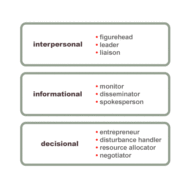
Research on Managerial Roles by Henry Mintzberg and Peter Drucker Henry Mintzberg, the canadian academic observed a few managers and analysed their behaviors and arrived at some conclusions which are listed in the table below. He also identified and attributed ten managerial roles of significance in correlation with the managerial functions. S.NoManagement Functions% of time spent1.Relating to external environment1.82.Planning and setting Objectives19.53.Decision-making6.04.Organising15.05.Leadership and inter-personal role28.46.Communication12.67.Control12.78.Staffing4.1 This table very clearly explains the role of a manager as a leader and the extent of influence he exerts on his sub-ordinates. Proper planning and goal-setting are the key contributors for the successful functioning of a firm. LEADER VS. MANAGER Coming to the managerial roles they can be classified as, 1. Interpersonal roles 2. Informational roles 3. Decisional roles Inter-Personal Roles: Figurehead role– The function is more of a ceremonial nature, like attending the family functions of employees, greeting visitors and a manager performs the symbolic duties of a head of the organization.Leader– He has to plan the HR requirements and motivates the staff to perform well. “Managers are people who do things right; leaders are people who do the right thing.” Remember a manager has to be a leader whereas it is not so in the case of a leader.Liaison– The manager acts as a link between the organization and the external environment to build image and rapport. Informational Roles: Monitor– The manager has to update himself with the current scenario in order to utilize the information for organizing and prompt decision-making.Disseminator– The manager has to communicate and distribute information to his subordinates to effectively accomplish the enterprise objectives.Spokesperson– Efficiently has to communicate the company’s policies to prospective clients and others. Decisional Roles: Entrepreneur– He has to be innovative by adapting to the changes in the environment. He has to be adventurous, persistent and strategic during tough times.Disturbance handler– He has to find appropriate solutions to problemsResource allocator– He has to apportion and allocate resources properly besides delegating authority to the work forceNegotiator– He has to negotiate resources outside and conflicts inside the organization. MANAGERIAL DIMENSIONS Managing: Science or Art? One perspective is Managing, like all other disciplines- whether medicine, music composing or even cricket is an art. It is “know-how.” Still managers can use the organized knowledge about management to perform better. So let us put it this way, Managing as practice is an art; the organized knowledge underlying the practice may be referred to as a science. Let them be complementary to each other and be present in peaceful co-existence. Drucker “ON MANAGERIAL FUNCTIONS ” – A manager has to look after The specific purpose and mission of a firmIncrease productivity by making the employees more productiveConsiderate about social impacts and social responsibilities In his view, the areas a manager has to focus and concentrate are 1. Market standing 2. Innovation 3. Productivity 4. Financial and Physical resources 5. Profitability 6. Manager performance and development 7. Worker performance and attitude 8. Public responsibility He says that business has only two functions- marketing and innovation. While others were concentrating on products and commodities, he concentrated on people and their performance. His “management by objectives- MBO ” became a very popular concept though it faced criticism. MBO according to Drucker is a philosophy that rests on a concept of human action, behaviour and motivation. It sets personal goals (both shortterm and longterm) to be achieved by each individual working for the organization and coverts them into challenges to be accomplished, thus motivating the individuals. The Effective Manager The effective manager is a situational manager who evaluates each approach in the light of circumstances and selects the one that most effectively and efficiently achieve individual...