Posted by Managementguru in Business Management, Principles of Management
on Mar 3rd, 2014 | 0 comments
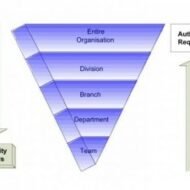
Centralization and De-Centralization Concepts CENTRALIZATION: The term “centralization” has several meanings: Centralization of Performance: Say, if the operations of a company is restricted to a single geographical location, it characterizes centralization of performance. Departmental Centralization: Specialized activities are carried out by a single department, say, maintenance of a whole plant, staff recruitment by HR department etc., Centralization as an aspect of management: This implies restricted delegation and exclusivity of decision-making by the top management. According to Allen, “Centralization is the systematic and consistent reservation of authority at central point in an organization.” According to Weihrich and Koontz, “Centralization (as an aspect of management) is the tendency to restrict delegation of decision-making. What are the special circumstances that force the managers to reserve authority and centralize decision making powers? 1. To facilitate personal leadership 2. To provide for integration 3. To handle emergencies 4. To utilize resources effectively and instantaneously. DECENTRALISATION: It is the tendency to disperse decision making authority in a structured and organized manner. It can be viewed as a philosophy rather than a principle where-in “discretion” plays a major role in deciding which decisions to push down into the organization structure and which to hold near the top. Capital expenditure, Investment analysis and major policy decisions have to be dealt with, by the top management. It is the systematic effort to delegate to the lowest levels of authority except that which can be exercised at central points. TYPES OF DECENTRALIZATION: Three approaches to the concept are: 1. PROFIT CENTRES 2. COST EXPENSE CENTRES 3. INVESTMENT CENTRES Profit Centre: Here the organization is split into divisions on a “product basis” and is given full authority to handle its own scheduled operations, right from placing orders to negotiating the sale of its finished products. Cost Expense Centre: Whenever it is easy to determine the cost of operations, cost centres are established. Cost centres run on “budgets” which acts as a control tool to run the units within the specified budgetary limits. Investment Centre: Useful in the case of big multi-product enterprises where product performance is measured by decentralizing the investment aspect. Each strategic business unit is responsible for the acquisition, use and disposition of fixed resources. Advantages of Decentralization: Managers and executives are relieved form excessive work pressure Even low level employees are involved in decision making thus bringing the decision making process closer to the scene of action. It facilitates product-diversification Creates an opportunity for learning Ensures effective control When a big organization is divided into relatively smaller units, it becomes flexible and also effects close control. Disadvantages of Decentralization: · Conflict arises between people belonging to different levels of the organization · Rising cost · Lack of co-ordination between production and marketing departments · No defined leadership Contingency Factors in Decentralizing: 1. Organizational goals 2. Organizational size 3. Geographical dispersion 4. Technical complexity of tasks 5. Time frame of discussions and decisions 6. Subordinates’ take on issues 7. Planning and control procedures 8. Environmental factors 9. Knowledge and experience of managers Effective Decentralization can be accomplished by · Establishing appropriate centralization · Developing efficient managers · Proper provision for communication and co-ordination · Establishing adequate controls Top management must be willing to delegate authority towards decision making; Middle management must be willing to accept responsibility that is being delegated. Only then effective decentralization is...

Posted by Managementguru in Business Management, Human Resource, Principles of Management
on Mar 2nd, 2014 | 0 comments
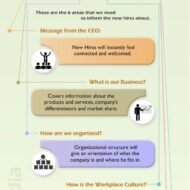
Objectives and Functions of HRM Human Resource Management is very challenging because of the dynamic nature of the people and it is not only managing men but involves administering a social system. According to Dale Yoder “Man power management is the function or activity in directing working men and women in maximizing their satisfaction in employment.” George R. Terry says, “Personnel management is concerned with the obtaining and maintaining of a satisfactory and satisfied work force.” OBJECTIVES OF HUMAN RESOURCE MANAGEMENT: 1. Social Objectives: a) Facing the challenge of unemployment and providing people with maximum employment opportunities is the first and foremost priority of countries like India where there is pressure of population growth. b) The employees must be able to derive maximum satisfaction from the work performed. c) The system should facilitate harmony and co-operative endeavor for one and all. 2. Personal Objectives: Job satisfaction and rewards in the form of pay, promotion and recognition is aimed at, on the part of employees. This can be achieved by providing adequate remuneration, opportunities for advancement, facilities for training and development, job security and proper work. 3. Enterprise Objectives: This can be achieved by selecting the right people for the right job, empowering them through training, development and participation. FUNCTIONS OF HUMAN RESOURCE MANAGEMENT: 1. Planning: Assessment of future man power requirement is done with the help of man power inventory chart followed by the recruitment and selection process. A clean job description is needed to lure people with the right skills for the right position. It is the responsibility of the manager of a firm to lay down specifications of the qualities and skills required by the workers and determining sources from where the workers are to be recruited. Selection is done by means of written test and personal interviews. 2. Organizing: This involves proper designing of organizational structure, the inter relationship between jobs, establishing smooth channels of communication, assignment of authority, responsibility and creating accountability, establishing line and staff relationship etc. 3. Directing: Issuing orders and instructions down the line and motivating the work force to carry out those instructions satisfactorily. Positive motivation in the form of financial and non-financial incentives, a good working environment is essential on the part of the management. 4. Controlling: The motive is to ensure that performance of each worker coincides with the plans or standards. Bench marking, Total quality management and Six sigma are some of the popular concepts of standardization. → Scope and Characteristics of...
Posted by Managementguru in Business Management, Principles of Management, Training & Development
on Mar 2nd, 2014 | 0 comments

Manpower development today goes beyond simply filling positions – it’s about strategically planning, nurturing, and aligning human resources with the long‑term vision of the organization. It involves accurately determining both present and future workforce needs, while designing the right organizational structure to ensure the right mix of managers, specialists, and employees are in place to drive growth. Key Elements of Modern Manpower Planning 1. Present Workforce Analysis The first step in manpower planning is to assess the current workforce. HR teams collect data on employee demographics, qualifications, skills, training, and experience. Example: A tech company may analyze its developers’ coding skills, certifications, and project experience to identify gaps in AI or cloud expertise. Tools like HR analytics dashboards and talent management systems make this process faster and more accurate. 2. Manpower Inventory Chart A manpower inventory chart provides a clear picture of staffing levels and future talent pipelines. It helps HR leaders: Understand current staffing levels Identify employees ready for promotion Forecast internal talent supply Spot performance gaps for training Plan succession for retiring employees Resolve overdue promotions fairly Example: A retail chain may use this chart to plan for seasonal hiring, ensuring enough staff are available during holiday sales. 3. Job Evaluation and Job Analysis Job evaluation ranks roles within the organization, while job analysis defines the skills and responsibilities required. This ensures clarity and fairness in compensation and career progression. It highlights: Nature of work performed Methods and processes used Skills, education, and training required Interrelation of jobs across departments Work environment conditions Example: In a healthcare organization, job analysis ensures nurses, doctors, and administrative staff have clearly defined roles to avoid overlap and confusion. 4. Job Descriptions A modern job description is more than a list of duties—it’s a branding tool that attracts the right talent. It includes: Job title Core duties and responsibilities Authority and accountability Required qualifications and skills Example: A startup may highlight flexible work culture, innovation opportunities, and growth potential in its job descriptions to attract millennial and Gen Z talent. 5. Short‑Term and Long‑Term Goal Alignment Workforce planning must align with business goals. Short‑term goals may focus on immediate staffing needs for projects. Long‑term goals anticipate future skills required based on market trends and technology shifts. Example: An e‑commerce company may plan short‑term hiring for logistics staff during festive seasons, while long‑term planning focuses on AI engineers for predictive analytics. 6. Demand and Supply of Talent The demand for skilled talent is higher than ever. Organizations must balance internal talent supply with external recruitment. Inter‑departmental transfers may solve short‑term gaps. Long‑term solutions require strategic hiring, reskilling, and succession planning. Example: A manufacturing firm may reskill machine operators in automation technologies instead of hiring externally, ensuring loyalty and cost savings. Why Modern Manpower Planning Matters Ensures future‑ready workforce Builds employee engagement and retention Supports business scalability Aligns HR strategy with organizational...
Posted by Managementguru in Business Management, Organisational behaviour, Principles of Management
on Mar 2nd, 2014 | 0 comments
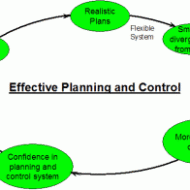
Principles of Planning and Forecasting The guidelines of principles of planning are as follows: 1. Principle of primacy of planning: As discussed earlier planning is the prime function of management and precedes all the other functions. 2. Principle of verifiable objectives: The objectives set must be clear, achievable and verifiable in order to attain a feasible management model. 3. Principle of planning premises: The contributing factors in the external environment are government policies, economic factors, market standing, and consumer preferences etc. that decide the success of planning. Planning is done based on these assumptions but nevertheless, all the factors external to the business have to be thoroughly analyzed to ensure concrete planning. 4. Principle of limiting factor: Cost is one of the major limiting factor; production cost has to be factorized to ensure economy of scale and potential resources needed for a business in the likes of men, material and other physical resources have to be taken into consideration. 5. The commitment principle: Planning and decisions whether short term or long term is valid only for a particular period. The long term plan is nothing but the future impact of today’s decisions. Decisions concerning new product development by a company aims at creating an impact for the next 15 years or so while decisions concerning sales target has to be accomplished on a periodic basis- monthly or quarterly. 6. Principle of flexibility: A plan should be flexible and give room for contingencies like losses incurred through unexpected events. 7. Principle of navigational change: Plans while suggested to have built-in flexibility are also subjected to periodical review in the light of environmental fluctuations. A business can not stick to a long term plan devised originally since it is equally important to check on events and expectations periodically. FORECASTING AND PLANNING: Forecasting is a management technique that relies on both past experiences and present assumptions to predict the future. Again this serves as an important premise for the planning process. The conditions of the external environment though out of one’s control, if properly estimated, can lead an organization to produce wonderful results. TYPES OF FORECSATS: Economic forecast: To gauge the general economic scenario and its effect on sales. Technological forecast: To predict what new technologies can be developed, when and how to bring feasibility to the operations involved. Competition forecast: To look into the competitor strength and tactics and know where one stands. Social forecast: To predict the attitude of people and social conditions. Supplier’s forecast: Reveals the response of suppliers. FORECASTING TECHNIQUES: 1. Quantitative time series analysis: Monthly sales data is plotted in a chart and the past data helps in consolidating the sales volume and fluctuations in sales. Sales trend is determined and the assumption is that, the future will reflect the past and present trend and hence can be projected. If there is a lull in sales, reasons for the decline can be known by taking feedback from various quarters like, suppliers, consumers and employees. 2. Derived forecast: The forecast done for a specific purpose may be reused for another purpose. For example a census data can help you to determine the demography of a particular geographical area that might help you to reach your target customers. 3. Casual methods: If the underlying cause for the variable can be determined, the forecast can be arrived mathematically and produce quite accurate results. Social media marketing is very popular now a days and instantly you know how many hits are received for a particular product and the ratio of conversion into sales. 4. Brain storming: People with knowledge and expertise assemble in order to discuss the pros and cons of a particular idea, be it the launch of a new product, product promotion or withdrawal of a product line. 5. Delphi method: In this method, each and very expert is contacted independently and opinions are drawn...
Posted by Managementguru in Business Management, Organisational behaviour, Principles of Management
on Mar 2nd, 2014 | 0 comments
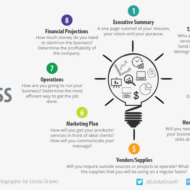
Your business structure will affect a lot of factors – You can start with an initial business structure and change it as your business thrives. But first and foremost you need a solid business plan that details your mission, vision and purpose. These 7 steps in planning will guide you through and give your project a headstart. The business plan cheatsheet is given in a pictorial form for your benefit. ☝️ A. Opportunity Analysis: SWOT analysis– the analysis of strength and weaknesses, opportunities and threats in the external environment is the first and foremost step in planning. The target market, competitor strength, internal weaknesses, customer’s preferences are some of the key areas to be focused. B. Setting objectives: Where we want to be, and what we want to accomplish and when are answered in this step. Each and every employee of the organization has to be apprised about the enterprise objectives in order to achieve the expected or desired result. Management by objectives is one of the proven methods where-in the objectives are set by the subordinates themselves under the guidance of their superior and periodical reviews are conducted to check whether the set objectives are accomplished within the stipulated time. C. Developing Premises: The critical factors that affect the planning process are analyzed thoroughly. Say, government policies, business cycle trends, economic indicators, inflation, tax rates etc are analyzed and the plans are developed based on these premises. D. Identifying Alternatives: It is better to have an alternate plan or plans which helps in deciding the alternate course of action. Alternatives identification is a technique used for identifying different methods or ways of accomplishing the work of the project. For example, brainstorming might be used to discover alternative ways of achieving one of the project objectives. E. Evaluating Alternatives and selecting the suitable plan: The limiting factors can be set as a criterion for evaluating the alternatives. The limiting factors may be cost, time, manpower and other resources. Operations research helps in the assessment of alternatives and selecting the best. Think about this, if plan A fetches you more profit but proves to be expensive and plan B fetches you consistent profit and less expensive, what will be your choice? Even banks look into the fund flows of different projects submitted by clients and select the ones that proves to fetch consistent returns on the long run. F. Formulating Supportive plans: Download this Business Planner Printable which comes in handy when you want to weigh your choices👇 Business-Journal-Planner-1Download Derived plans are those that stem from the main ones that support the basic plan. Recruiting and inducting may be the basic plan of a HR department but training and development is the supporting plan that gives shape to the basic plan. G. Developing Budgets: Budget is referred in financial terms and they are required to control plans. There is always a constraint for resources and hence it is the responsibility of a manager to decide on the investment in a particular plan that will tide away the risk of the...