Posted by Managementguru in Human Resource, Marketing, Sales
on May 2nd, 2018 | 0 comments
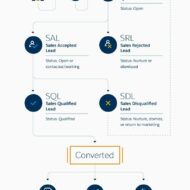
This is an article crafted by Salesforce Marketing Cloud in tandem with Ghergich & Co.. specialising in SEO and Content Marketing, that gives companies advice on revamping their lead management process. Because proper lead management is a task for multiple departments, this article shares insight on how to help the departments work together, as well as how to use marketing automation to improve your lead handoff process. You can view the original article here- → How much do you really know about and use your lead management software? What does it do for you, and how can you make it work harder? Well, one of the ways to make it work harder is to make your team work harder—and we’re not talking about just the sales team. We’re talking about everyone: helping them understand the process, helping them understand the responsibilities, and helping them learn how to use the management software to create a system that’s robust and fulfilled. One of the key uses of any lead management system is to help qualify leads, because not every lead is the same. Some are high quality, and may be further into the possible sales pipeline than others. Some may be in the process of being nurtured, while others are rejected. So how do you learn more about software and how do you use it well? This graphic offers an explanation. Are you used to hearing the words “no” “nope,” “not interested?” Your prospects are rejecting you for a number of reasons. Here are the most common reasons why? You’re not reaching out to the right people. Your product is not the right fit. They weren’t ready to make a decision. They prefer your competitors. They are just not interested. How your sales behavior affects your pipeline? Buyer behavior is changing; it’s harder to reach potential customers. They demand more information and service from sales reps before making a decision. But many sales professionals are failing to adapt to this new game. 40% don’t have a well-defined sales process in place and only half feel they’re good at gaining access to key decision makers. Lead Nurturing: Companies that excel at lead nurturing generate 50% more sales ready leads at 33% lower cost. Nurtured leads produce on an average, a 20% increase in sales opportunities versus non-nurtured leads. Nurtered leads make 47% larger purchases than non-nurtured leads. Lead generation focuses on pouring as many leads as possible into the top of the funnel. It generates interest, brings visitors, increases web traffic, and prompts these viewers to fill out contact forms or call a phone number. But that’s as far as it goes. Pipeline marketing sees the entire funnel holistically. It sees lead generation as only one small piece of a larger puzzle. Rather than aiming for volume, Pipeline Marketing aims for quality and readiness-to-buy. Also, these leads are tracked through the entire funnel, which allows pipeline marketers to see which channels, ads, content, and other marketing touchpoints, contributed to the bottom line. Info Courtesy: Dailyinfographic...

Posted by Managementguru in B-Schools, MAT EXAM
on Feb 28th, 2018 | 0 comments

MAT is an easier version of CAT Know How MAT 2018 is a Brilliant Opportunity for MBA Aspirants The Management Aptitude Test is a great opportunity for aspirants who are willing to pursue their education in management. MAT is comparatively a less competitive exam unlike CAT, which is considered to be one of the toughest examinations for entering into top management colleges like IIM’S. Results are the most uncertain part of examinations. Some tend to clear it with flying colours whereas some might not live up to the mark. After witnessing your results for CAT 2018, some must be gleaming with joy while others might be disheartened for they could not score well. Well, if you consider yourself as someone who didn’t perform well or if your CAT Result did not leave you satisfied, do not get demoralised but keep thriving for success. Your dream of securing admission into a good management B-school is still possible by appearing into exams like MAT 2018. MAT equally attracts a good number of management B-schools who offer admissions into their PGDM courses. It is generally conducted 4 times in a year wiz February, May, September and December in both online and offline mode. The exam consists of five sections comprising of 200 questions in total. We can easily say that MAT is an easier version of CAT. Hence, MAT 2018 is an ideal choice for anyone aiming to secure admission in MBA in a good management institute in India. There are many benefits associated with MAT 2018 which prove that is a great opportunity for MBA aspirants. Let us have a look at some of those benefits: Lower difficulty level This is the first and foremost factors which distinguish MAT from other management exams. In comparison to other major MBA entrance examinations, like CAT, XAT, SNAP etc. MAT is of a much lower level in terms of difficulty. If the student is already well versed with the syllabus of CAT or other major MBA exams there is no extra preparation needed for MAT as the syllabus is same. Just a small recap or revision into all the topics that you had prepared for CAT 2018 , would be enough for clearing MAT 2018. For instance, a student who has secured let’s say around 60-70 percentile in CAT can easily score an 80+ percentile in MAT with a strong level of preparation and practice. Many students also end up scoring 800/800 in MAT which clearly indicates the difficulty level of this exam. Wider Choice of B-Schools MAT offers a wide choice of management b-schools to select from which makes it a very lucrative option for students. There are more than 600 management institutes which accept MAT scores across the country, which is probably the highest in number in comparison to any other entrance examination. As per AIMA, the management body which conducts MAT every year “It is the largest test of its kind in India”. Gateway to Best Colleges MAT is also a gateway to some of the best MBA colleges in our country such as Jamnalal Bajaj Institute of Management Studies (JBIMS) which ranks among the top 10 management colleges of India. Chanda Kochar, Uday Kotak and Mani Ratnam are some of the most eminent personalities who are distinguished alumni of JBIMS. The list doesn’t ends here; colleges like KJ Somaiya Institute of Management & Research, SIMSREE, NL Dalmia Institute of Management also accept MAT scores for admissions. Multiple attempts in a year Since, MAT is conducted four times in a year; candidates get a chance to appear in MAT more than one time if they haven’t scored well. You save a lot...
Posted by Managementguru in Human Resource, Social Media
on Feb 21st, 2018 | 0 comments

Social Media May Make You Lose Out On That Job Don’t forget that everything you say online stays there, and anyone can see it including probable employers, former bosses, or current work mates. Any dubious photos, potentially offensive comments, and criticisms against current or former employers may come back to trouble you. Fama has come out with a resourceful post on what shouldn’t you be doing on social media that might cost your job. Read on… Social media screening has now become an essential part of the corporate world. With information being widely accessible through the World Wide Internet, many internet users’ lives are now an open book. Luckily for the HR department, this makes screening out bad characters a breeze. Those embarrassing posts that you had made years ago on your social media account may come back to bite you if it was in your real name. With corporations being concerned about public and especially online image, they are cleaning out bad characters that could potentially compromise things. This is where Fama’s vision comes into play, as they are now the largest producer of social screening technology in the world. Should we embrace it? Social media can bring out the worst in even the quietest person. Although it may be abused by HR department to essentially isolate people that have certain opinions, it may be useful to block toxic people out of the workplace. For instance, somebody who creates blog posts on Facebook regarding violence or suicidal tendencies may not be the coworker that you want next to you. Although a long-shot, you will be glad that social media screening could mitigate the chance of a workplace shooting. In another instance, it can also help thwart potential thieves and scam artists. Although it is quite silly, there are some people that brag about their criminal endeavors or workplace conflicts. It would be easy for the HR department to dodge a bullet by filtering out the troublemakers. A Resourceful Infographic from HireRight on Background Checks done by Employers through Social Media: Could it be abused? Of course, some people are worried about the immoral usage that could go along with the power of social media monitoring. For example, having an unpopular political opinion may offend your boss and cause employment to be terminated. In many parts of the world, this type of discrimination is contestable in court but it may also be difficult to prove. How to navigate social media with coworkers? When it comes to navigating social media with regard to work contacts, it can be hard to decide who to friend or follow, which requests to accept, and what you should allow your professional contacts to see on your profile. And it’s not just a matter of job security (although posting pictures from the beach when you’ve called in sick could certainly lead to that type of problem); there’s also the fact that seeing how coworkers act in their off hours and what they choose to post could create significant changes in your workplace dynamic. At the end of the day, it’s up to you to decide what feels right when it comes to social media connection, and factors like your personal demographic, the social media platform in question (as well as how you use it), your industry, and your role at the company may influence your choices. Take a look at this infographic to gain a better understanding of what you should consider before connecting with your colleagues on various social media platforms. Don’t Make Mistakes Social media is also the main way to keep tabs on employees during their supposed sick days. If you make an...
Posted by Managementguru in B-Schools, How To
on Feb 13th, 2018 | 0 comments

Mathematics Section of CAT- What Makes it Unique than Other Management Tests CAT, conducted for admission in the Indian Institutes of Management is also accepted by other, top B-Schools across the country for admissions to MBA, PGDM and other management courses. The registrations for the examination begin in the first week of August and the official notification is released along with the application forms. CAT hall ticket is then released for the candidates who successfully apply for the exam. The exam is divided in three sections: Quantitative Ability, Verbal Ability & Reading Comprehension and Data Interpretation & Logical Reasoning. Among the three sections, the Quantitative Ability section carries a weightage of 34% and the allotted time for the section is 60 minutes. Also, this is considered the trickiest of the three sections. Why is the Quantitative Aptitude Section of CAT unique? The quantitative section of Common Admission Test is different than other management exams, mainly because of the difficulty level. The questions asked in this exam are much more difficult and lengthy. The difficulty level has also increased over the years, making it the most feared section by students. The syllabus for the mathematics section is also quite vast. Judging by the last few years’ trends, algebra and geometry are two of the most important parts of this section. CAT, sometimes does not follow previous year’s pattern, particularly for this section, making it very unpredictable. Some years had questions on arithmetic and number system dominating major part of this section while some years had maximum questions on algebra, geometry and higher mathematics. So students preparing for selective topics may be taken by surprise. The mathematics section of CAT is important because if the score of this particular section is less, the student will not be considered for IIMs despite scoring well in the other two sections. Considering last year’s admission trends, IIMs demand 85 to 90 percentile in mathematics section to shortlist candidates for GD PI rounds. So you need to prepare for the quantitative aptitude section with utmost seriousness. How to Prepare for Quantitative Aptitude for the CAT In the following paragraphs, we will discuss some of the topics students should focus on to obtain a good score in mathematics. Number System Number system can be called a low priority area for CAT mathematics preparation because the questions on this topic have decreased in the last few years. Nevertheless, the concepts should be learned to solve the questions that are asked. Some of the most important topics to cover include– Basics and properties of numbers Base System – conversion of bases, addition, subtraction and multiplication in different bases HCF & LCM Finding out last digit, last two digits, number of zeroes Divisibility Rules Long division and finding out remainders – on this topic the questions are mainly based on divisibility rules, binomial theorem, simplifying the dividend, Wilson’s Theorem, Fermat’s Theorem, Euler’s Theorem, pattern recognition, cyclicity of remainder. Arithmetic The main trick to master arithmetic part is to learn the concepts properly and apply short methods for calculation. The basic concepts that you will need to follow for solving most of the problems are- Averages Mean, median, mode Percentages Ratio and Proportion Simple and Compound Interest. Observing previous years’ patterns most of the arithmetic questions are asked on the below mentioned topics – Profit & Loss Mixture & Alligation Time & Work – pipes & cisterns Time & Distance – basic concepts, relative speed, linear and circular races, boats & streams, relative speed, escalator based questions Few other topics from the syllabus that the students can learn for concepts are– Stocks & shares Calendars Clocks The concepts should be learned...
Posted by Managementguru in How to Blog, How to make money online, Sales
on Jan 22nd, 2018 | 0 comments

There are many tools you can use to create information products and sell your products. Let us have a look at 10 Ways You Can Make Money From Your Blog! 1. Ebooks Creating ebooks is one of the easiest ways to create information products. Ebooks can be simply written in a word doc, exported to a PDF and then you are done. You can collate your top posts and compile them in an ebook and sell them on your blog. You can sell the ebook anywhere from $7 to $25. Courtesy: Become A Blogger Download Daily and Weekly Planner Printables 2. Membership sites Membership sites is another way to build information products and create recurring revenue every month. It can be difficult to create membership site but when you create a tribe and establish your brand, then you can create membership sites and create features useful for your readers. Until you have created your own following and established your brand, you can hold off creating a membership site and build your brand. 3. Video courses Video courses are something which everyone can make. You can either create video-based courses or slideshows to create content for students. There are different platforms to create your courses like Thinkific or teachable which allows you to create courses. It is easy to set up courses and create different pricing plans for your courses. Courtesy: Powerful Tips for Producing Effective e-Learning Videos 4. Email coaching Email coaching is another way where you can make money by offering your services by guiding the reader in solving their pain point by coaching them over the series of emails. You can easily coach anyone over email and keep a track of communication over the email. 5. Email courses Another way to create an info product is to create email courses where you send a series of emails as a paid info product. The biggest downside of an email course can be the student treats an email course as any other email and this can drive down engagements of your course. 6. Blog audits You can do audits or reports and analyse the results of other people’s blogs or content. When you provide such a service, you should detail everything that you will provide to the client. Be specific with what you would provide in return and provide a guarantee on what you provide in doing a blog audit for a blogger. 7. Apps or software Creating apps is another way you can create income from your blog. Suppose, you have a food blog or a fitness blog, you can have an app which showcases food recipes or exercises. You can also create a software which can solve a pain point for the custoemr and solve a problem. Another way to make money is by creating a website theme which can sell on your platform and can also be used to build an email list. 8. 1-on-1 coaching Your audience may want to get on a 1-on-1 coaching with you to get more information from you to help them to get better at their business or blog. When you do a one on one coaching, be very specific on what you can offer to your client. If you are doing a session of one-hour coaching where you charge $50 per hour worth of coaching, then make sure you are not providing 3 hours of free content to the reader. You should use a scheduling software setup to keep a track of the time offered by you to your clients. Be specific with what you will offer in your coaching. 9. Ads Ads is a monetization option which is...