Currently Browsing: Technology
Posted by Managementguru in Business Management, E Commerce, Marketing, Sales, Social Media, Strategy, Technology, Website Design
on Dec 4th, 2020 | 0 comments

Creating an E-commerce website that positively appeals to customers is tricky. When potential customers click on your site, you want to lead them to the shopping basket rather than the x in the corner. To do this, your goal is to make it as user-friendly and professional-looking as possible, and here is how you can do just that. Stay Simple The key to a professional-looking, easy to use website is to keep it as simple as possible. When it comes to your business, you will most likely want to show off everything you have to offer as soon as possible, but it helps to strip it down. On the homepage, don’t overload users with content. When it comes to description, you should keep it short and succinct, letting users know your purpose without bombarding them with a large chunk of text. Think about when you click on a website. Are you more likely to stick around if the information is clear and easy to read, or if there is a messy mixture of words and images overloading your eyes? Keep your customers engaged by keeping your website as clean as possible. A Clear Contact Page Your customers need to be able to contact you easily. This means your contact page must be easy to find, and when clicked on, the contact numbers, email, and address should all be clear. Use Chat Bots Customer service is an important part of an E-commerce site, and one of the cheaper and easier ways to provide consistent communication is the use of chatbots. Using AI, chatbots allow quick interaction with customers on your site. It means that you don’t have to constantly check messages to provide excellent customer service to your website users. Find Outside Help Building a functional, professional-looking website isn’t as simple as you would think. It takes time, creativity, and decent background knowledge of web development. Not to mention the ability to create engaging content. An SEO agency will help give your website consistent content to bring more users in and engage the customers who are already there. If you sell clothing, for example, your talent might not lie in content creation and website building, but not having them will negatively impact your sales. Finding a professional to help you could make all the difference in bringing you more sales. Use the Right Colors Color is a huge part of the overall image of your E-commerce website. Don’t simply choose your favorite colors, and avoid making your site look like multiple rainbows (unless it directly ties into your brand’s image). Think about what you are selling and who your customers are. If you are a kid’s clothing website, for example, bright, primary colors would work well. Generally, the rule of three is a useful rule to stick to. If you’re struggling with the aesthetic, then a web designer will help you find the colors that make your website pop. By creating a clear, easy-to-use, and aesthetically pleasing website, you ensure more of your site’s users turn into...

Posted by Managementguru in Artificial Intelligence, Financial Management, Technology
on Sep 8th, 2020 | 0 comments
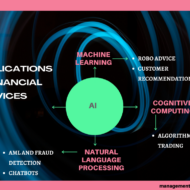
Artificial Intelligence (AI) is transforming industries across the board, and financial companies and institutions are moving fast to keep pace. AI is changing the way we apply for loans, file insurance claims, invest our money, and interact with our banks. Here are some of the most prominent AI trends that are making inroads in the finance industry. Fraud Detection and Management As e-commerce is rising in popularity, so is online fraud. To prevent frauds, many e-commerce platforms and card issuers have been forced to decline transactions too aggressively. According to a study by Javelin Strategy, retailers lost almost $118 billion in 2015 due to false declines. Moreover, more than a third of cardholders abandoned their card because it was falsely declined. To detect fraud and prevent loss of revenue, many financial institutions have turned to AI. Machine learning algorithms can reduce false declines and improve the accuracy of real-time approvals because they can identify fraudulent activities that would go unnoticed by humans. Recently, Mastercard has launched its own AI-based fraud prevention system. Mastercard’s technology gleans patterns from the historical spending habits of shoppers. It uses this data to set a behavior baseline that allows it to score and compare new transactions. It is not limited to predetermined rules. Traditional fraud detection systems, on the other hand, use a one-size-fits-all approach when evaluating transactions. Since Mastercard processes countless interactions each year, they have plenty of quality data they can use to hone and train its AI fraud prevention system. Thanks to machine learning, AI fraud detection systems learn on their own and improve themselves over time. AI systems can also automate AML (Anti-Money Laundering) and KYC (Know Your Customer) compliance. Virtual Assistants and Chatbots Thanks to machine learning and natural language processing (NLP), chatbots and virtual assistants can deliver human-like interactions. There are more and more virtual assistants that are designed for various niches within the finance industry. Banks and other institutions use virtual assistants and chatbots to offer personalized conversational experiences to their clients. Unlike human agents, virtual assistants can juggle multiple accounts at once, and they are always available. They allow customers to get assistance outside of office hours. Banks, brokerage firms, and insurance companies can use chatbots to reduce the workload of their call centers. By offerings comprehensive self-help solutions, clients can successfully apply for loans, get personalized financial tips, or file claims much faster. For instance, the AI Insurance Claims Assistant can help and re-engage with customers throughout the complete claims process. It can gather the required information for processing and update the customers on the status of their claims. They also have digital workers that can automate the onboarding journey, help customers figure out their coverage needs, update their information, or make policy adjustments. Banking bots, on the other hand, can help customers optimize their financial plan by intelligently tracking their income, spending habits, and essential recurring expenses. They can also help customers open an account and remind them to pay their bills. Risk Assessments As mentioned, one of the strongest features of AI is its ability to learn from past data. Since records and bookkeeping are an essential part of financial services, AI and finance go hand in hand. Credit cards are a perfect example. To determine if someone is eligible for a credit card, card issuers use credit score. But, business-wise, it doesn’t always make sense to group customers into “haves” and “have-nots.” Instead, financial institutions can use each customer’s data, such as the number of credit cards they have, the number of loans currently active, and information on loan repayment habits, to customize the interest rate on the card they have issued...
Posted by Managementguru in Cyber Security, Intellectual Property Rights, Social Media, Technology
on Mar 11th, 2020 | 0 comments

Social media security should be taken seriously if you want your company to thrive, your customers to remain safe online, and your brand representation to remain on top form. Unfortunately, there are people out there that may impersonate your brand or hack your social media accounts. If you want to keep your business safe, read on to find how to do so and what can happen if you don’t. Potential Threats The main threats that can harm your reputation and business are: Fake links which look like your website, but are actually a downloadable malware Impersonation accounts which could sell fake products to potential customers, leaving them unhappy with your brand Impersonating profiles of staff members to gain private and personal data Communication of wrong information which could affect the stock price Hacking of your social media profiles to gain confidential data or post false information The above threats can happen to any business, even small businesses, so you should never believe your business is immune to threats. Instead, you should follow safety advice to ensure your social media is safe from hackers and trolls online. The Cost to Your Business Unfortunately, social media scams such as the ones above can damage a company’s reputation and may lead to financial loss. Any customers who have fallen for this scam will have less trust in the company and will be likely to inform others, meaning many more people are less likely to trust your real profiles and website. You may even deal with negative press over the issue. If you haven’t taken the necessary steps to keep your social media accounts safe, you could be liable for paying back disgruntled customers. Best Social Media Safety Practices There are several simple steps you can take today to implement a safer and more secure way of working with social media, here are a few ideas to get you started: Change passwords regularly, and make them randomised Form a company social media policy that must be signed by each employee Regularly search for your brand name on social media to ensure there are no fake accounts Never list vacation times of management on any social media accounts, whether this be your own personal account of your business account Update your privacy settings regularly, especially if employees have left the company Permanently delete unused accounts Inform your customers if you are aware of any dangers or fake accounts associated with your company If you want to keep your business safe from fake profiles, consider using online brand protection services for businesses. FraudWatch International can protect your company by detecting and removing impersonating profiles from social media, as well as in many other ways. Check out their website for more information on how they can help you to keep your business safe. Being safe online is important for all businesses. Social media is a fantastic, free tool that can drive sales and improve customer retention. Follow the above steps to maintain safety and your company’s...
Posted by Managementguru in Business Management, How To, Intellectual Property Rights, International Business, Marketing, Strategy, Technology
on Dec 14th, 2019 | 0 comments

How to File a Patent for Your Invention Inventors are highly prized in any market, since their work is often the focal point that other infrastructure, marketing, and production coalesce around. But as an inventor, whether in a startup or independently, it is important to make the most of any invention you create. This means protecting your original work legally. In this article, we look at one of the primary tools at the disposal of any inventor: the patent, and how to file one. Why File a Patent? Patents provide a level of economic security and market edge for their holders. They are specifically designed to incentivize invention and innovation, offering an avenue to significant potential profits for an invention that is patented quickly and correctly. Patents fall under the category of intellectual property (IP) law, and are one of four kinds of IP protection, the others being copyrights, trade secrets, and trademarks. Copyrights cover original creative work, trade secrets involve confidential information that benefits a company competitively, and trademarks protect branding and brand identity. However, patents may be the most powerful intellectual property tool. Holding a patent grants a twenty-year monopoly (in the United States) for the development, production, and sale of the invention in question. This means that no other companies can compete via imitation for this time period, allowing the best possible version of the invention to be produced and sold, gaining more profits by being a unique entity in the market. Filing a patent can make the difference between being swallowed by competitors who have the infrastructure to take your idea and produce it more cheaply or more quickly, and having the time and resources to perfect your invention and get rewarded for its genesis. Sure, the patent filing process is time consuming and costs money, but the potential benefits are immense. Is Your Invention Eligible? The United States Patent & Trademark Office, or USPTO, outlines what is and is not eligible for patenting according to the patent statute codified in federal law. Eligible areas include a process, machine, “article of manufacture” (manufactured product), composition of matter, or “improvement of any of the above,” as well as specific designations for unique plant patents and design patents that govern the nonfunctional design and aesthetic components of a product. So, if your invention happens to be a machine or a composition of matter, is it automatically eligible for a patent? In short, no. There are additional requirements that must be met for patent eligibility. These boil down to usefulness, novelty, and non-obviousness. To have any chance of being granted a patent, the invention in question must be useful. Usefulness here can be very broad and does not only encompass crucial or definitive needs and benefits. Things like entertainment and enjoyment can also qualify as uses. Novelty refers to being sufficiently unique and new in order to deserve a patent. This can often be an issue of contention, with gray areas existing between what constitutes a slight tweak or variation upon an existing idea versus a truly novel improvement. Lastly, being non-obvious may seem quite easy, but this determination usually helps to weed out inventions that are not really inventions but obvious combinations of previously existing factors. Before delving into the patent search and filing process, it may be a good idea to seek out a qualified patent attorney or law firm to determine what the best course of action is, as a professional will better know how your invention might fare. Picture Courtesy: Taylorip The Patent Search Now that you’ve determined your invention may be patent eligible, it’s time to hone in on the...
Posted by Managementguru in Human Resource, Marketing, Project Management, Technology
on Oct 28th, 2015 | 0 comments

Best HR Apps For Your Business Development We all know how stressful a HR manager’s job could be. It is his department’s responsibility under his guidance to handle employee relations, payroll management, hiring and layoffs, rewards and remunerations, change and culture management. He can be compared to a mom who is always there to settle scores between son and father. Though the job is definitely tiring in nature, time has come for HR managers to heave a sigh of relief thanks to innovative HR apps that significantly reduces their workload. Apps for Rescue There are now apps that can completely take care of payroll management, network communication, project management, monitoring workforce leave, recruiting and performance management. Think about it, how much of time will be saved if there is some technology that helps you in tracking the sales force performance metrics (especially in IT companies where there are hundreds of thousands of employees), attendance, payroll, etc., Today’s technological scenario is something to be awed at and not to be taken granted for. Small organizations should push themselves one step higher to leverage the functionality of innovative technology for their business development. Download “55 ALL TIME POPULAR HR QUOTES” … Big Data – The Big Boss Data sits at the centre commanding all other entities to obey the rules laid by it. Even giants like Google can no more rely on their intuitions for decision making but rather go for numbers and information. HR is no exception when it comes to adapting new technology. Why can’t companies dare to use new software services – afterall nothing is lost! When you are in a situation to scale up your operations on one end and manage the tight competition on the other, yet you would not opt for a change! That does not make sense in any plausible manner. Think Fast Act Faster Let me introduce you to some of the interesting and enterprising HR apps (free as well as paid versions) that will give some room for HR managers to go for a long pending vacation with their family! It is better to automate your HR functions and please, please think over and above MS Office. Orange HRM: OrangeHRM offers you flexibility and freedom to select from free and paid versions of OrangeHRM backed with specialized expertise. Their HR modules cover core areas like payroll management, employee data management and many more. There’s the free option and paid enterprise version. And it’s all open source so if you have developers you can customize it to your heart’s content. App from Hay Group: Allows your managers to create job descriptions from a library of roles or generic templates defined by their experts, or you can completely start from scratch. Suggests the skills and behaviours needed for a role and gives feedback on job design so your managers know they’re on track. Expense on Demand: Expense On Demand will reduce the time needed to process expense claims by at least 50%. Claims are approved electronically and arrive in Finance department fully coded, validated and approved ready to be paid. Bamboo HR: BambooHR combines all of your employee information from all of your locations into a single view. You can then access, control, sort, analyze, and take action on the data instantly—from your office, the road or home. Kim Rohrer Head of People Operations / Disqus says “BambooHR frees up more time for me to follow my passion in helping people do their jobs better” Greenhouse: Make recruiting your competitive advantage through this app that optimizes your entire recruiting process. Find better candidates, conduct more focused interviews, and make data-driven hiring decisions. I’m listing a set...