Posted by Managementguru in Human Resource, Productivity
on Dec 19th, 2019 | 0 comments

Recruiting is an important process for any business. The way that you seek out and bring new talent on board can play a pivotal role in determining your success. Below are some simple tips for streamlining and standardizing your recruiting process so you get the right applicant every time. Establish a Consistent Process Having a consistent process that you and any other recruiters within your business are able to follow will ensure that you get consistent results as well. Whatever your particular criteria for hiring workers, it is important that they represent a set of tests that you can apply equally to all applicants. A consistent process will ensure that everyone involved is on the same page regarding what differentiates a good applicant from a bad one as far as your business is concerned. The clearer and easier to follow these criteria are, the easier it will be to consistently hire applicants who fit the bill. Define Your Key Indicators Exactly what it is that you are looking for in new recruits will depend entirely upon the type of business you run and the industry that you are operating, as well as the specifics of the job that you are hiring for. However, regardless of all of these factors, you should know what your key indicators are for every position that you interview for. Your key indicators are the things that will mark out the worthwhile candidates for you instantly. This may be particular aspects of their personality, or it may be a specific set of qualifications that all of your recruits need to have. It is vital that everyone is clear about what these are once you start the interview process. Look Beyond the Resume Your applicants’ resumes will be useful for getting some idea of what they’re like, but they will not tell you the whole story. The best resumes will come with some kind of personal statement, not just a list of qualifications and degrees. Look out for resumes that give you some information about who the people you are hiring actually are. You don’t necessarily have to only hire people that you get along with, but it is a good idea to make sure that everyone you hire is going to be a good fit for your business. Try and use applicants resumes as a way of formulating questions to ask them in order to dig beneath the surface and find out more. Consult with Other Employees Consulting with other managers and team leaders within your business will help you to identify any job requirements that are not immediately obvious to you. For example, if you are handling recruitment for an electronic business, you might know that you are looking to hire applicants who are proficient in PCB design, but you might not know that they specifically need to be able to use the PCB importer function in Altium. Talking to the members of your business who new applicants will be working closely with will enable you to identify any extra requirements beforehand. Once you have worked out a consistent recruitment plan, you should have no trouble hiring the best applicants for the job every single time. Recruitment isn’t rocket science, but it is easy to get wrong if you aren’t paying...

Posted by Managementguru in Business Management, Decision Making, How To, Human Resource, Productivity
on Nov 1st, 2018 | 0 comments
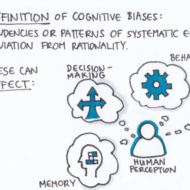
“If there’s something you really want to believe, that’s what you should question the most.” ― Penn Jillette To efficiently run a business, it’s necessary to think on your feet. You are required to make thousands of decisions and judgment calls daily. And while there is a wealth of information at our fingertips and communicating with colleagues or employees across the country takes only seconds, all this can lead to an information overload. In order to manage a business productively, we rely on mental shortcuts that allow us to get around this overflow of information. These mental tricks can also help us get around limits in memory, time, or a lack of information. These cognitive biases are necessary to help us make the sheer number of decisions necessary every day. However, cognitive biases can also lead you to make poor decisions and judgments regarding your business. Because they allow you to make decisions that don’t rely on logic, they can hold you back from doing your best work as a leader. That’s why it’s important to be aware of the common mental traps that you fall into as a manager of a small business. As your decisions can have a major impact on your bottom line, being more aware of your unconscious biases can help you find more success as a manager. For example, many people struggle with planning and scheduling projects. It is common for tasks to go out of scope or miss their deadlines. This is in part due to a cognitive bias called the “Planning Fallacy.” This bias causes you to underestimate the amount of time it will take to complete a task. However, once you are aware of this tendency, you can plan more time for your assignments than you think you will need and meet your deadlines. To help you in all your small business decisions, check out this infographic Fundera created on some of the more common biases and how to avoid...
Posted by Managementguru in How To, Learning, Productivity, Time Management, Training & Development
on Dec 20th, 2017 | 0 comments

Tips to increase your learning efficiency This article is well crafted by Anish Passi, Director at Neostencil, an Ed-Tech startup. Neostencil is an online and unique platform for UPSC Test Preparations where you can access live classrooms from the comfort of your home. NeoStencil offers you expert guidance for Civil Services exams, from doyens in this field, top teachers from popular IAS coaching institutes in Delhi, who have had years of experience in successfully mentoring the candidates to develop a holistic approach to their preparation for the exams. Learning is a continuous process, and one should always be keen to explore and learn more, anytime and anywhere. There is no better investment you can make towards improving yourself than acquiring more knowledge. When you are eager to learn, it will automatically improve your learning efficiency. Many times we have to improve our focus to learn something specific. For example, if an individual is preparing for UPSC examination, then you have to learn or prepare in a structured manner. Your UPSC exam training is time-bound for one. So, no matter what your general approach to learning is, at this particular time, you will need to put in a directed effort to improve your chance of qualifying as an IAS officer. Monitor your routine Now that you are preparing for an exam, your focus and energy must be diverted to achieve more in the given time frame. But, that should not be a cause for worry. You can keep stress at bay if you focus on learning fast and quicker than usual. By that we mean, you should attune your mind to find the value-add at every stage of your preparation. If you start looking for something new or in addition to what you know, you will look for resources, people and interaction with a purpose. You know what you are looking for and this way, you can achieve more than you hoped for. Open your mind You can only learn more if you have an open mind to invite suggestions and guidance. If you think you can do it all on own and don’t need assistance from people around you, then, you are at the risk of enclosing yourself in a closed box. Don’t make learning claustrophobic. It is good to read books, gain insight, but it is equally important to put that knowledge in a practical and constructive framework. It can only happen if you share knowledge and invite feedback, discussions, debates and even healthy arguments. It will make you more confident, and it will help you learn from a fresh perspective as well. Start using online chats, discussion forums, etc. Discover a new learning platform every day. Be self-dependent Since it is you and only you who knows what exactly you need to learn, it is therefore vital for you to be a self-dependent person. Take the initiative to be a part of learning forums like virtual ‘live’ classrooms and do it with the intention of contributing and participating in the discussion. It is essential to be visible in the discussion, reflecting exuberance and confidence. Also, always be inquisitive and interested to find out more, whatever be your source. You can learn by listening to others, and at times, you can learn better by debating on the same topic with others. It is as simple as that. Read and Read more Reading can help you gain a competitive edge. If you have an insight on the topic, then only can you discuss or share your knowledge with others. Reading enables you to understand every subject in detail and takes you in-depth, posing new questions, points and a unique perspective on...
Posted by Managementguru in Business Management, Decision Making, Principles of Management, Productivity
on Feb 26th, 2014 | 0 comments
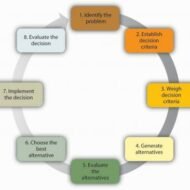
The Process of Decision Making There is a need to broaden our understanding about decision-making process. Decision making is not an independent entity and relies upon many other factors like precedence, social processes and random eventualities. It has three components; identification of the issue, the possible course of action and choosing the best amongst the choices of action available. The decision-making process is continuous since the business environment is dynamic and constantly poses challenges to the decision makers. Organizations are viewed as “Garbage can models” of decision making, in which actions, decisions and outcome are randomly mixed in the flow of events. With this introduction let us proceed to know more about the nature and types of decision making. NATURE OF DECISION-MAKING: 1. It is closely related to solving problems and issues 2. It is associated with all the important management functions like planning, organizing and controlling 3. Fayol and Urwick feels that decision-making is concerned only to the extent that it affects delegation and authority 4. Chester I Bernard in his “Functions of the Executive” says that the process is nothing but narrowing down of choice 5. Herbert A Simon considers decision-making as a process of intelligence, design and choice activities 6. According to Peter Drucker, it is a central part of the management process THE DECISION-MAKING PROCESS: The following steps are involved in the process of decision-making Recognizing the problem: Think about this; if there is a decline in the sales volume of your company or say if the value of your stock decreases, you are forced to make decisions to manage the contingency. In such situations, the first step would be to recognize or identify the problem area. A problem identified is half done. In this instance, the reason might be competitor strength or lack of necessary investment in the key strategic business units. Deciding priorities among the problems: A manager need not and cannot look after all the problems prevailing in the organization. He should know how to delegate authority and the responsibility that goes along with it. Subordinates can be entrusted with the handling of small and trivial problems while the manager can handle very important ones that might affect the functioning of the firm. He should ask the following questions to diagnose the situation. 1. What is the real problem? 2. What are the causes and effects of the problem? 3. Is this problem very important? 4. Can sub-ordinates handle this problem? 5. Which is the most pressing problem to be solved? Diagnosing the problem: Now the manager must start diagnosing the problem. Each and every individual has a different perspective and perceive the problem from a different angle. This depends upon the background orientations and training. The right way of approach for any manager would be to systematically analyze the problem for identifying the alternative courses of action. Developing alternative courses of action: This step involves creativity and innovative capabilities as the manager has to think from all possible angles and directions. Managers holding senior corporate positions are exposed to more of this kind of atmosphere where they are forced to make quick decisions in accordance with what the situation demands. Outside expert consultants are also put into use by some companies for developing choice alternatives. The following are the five PSYCHOLOGICAL STEPS for developing alternatives: 1. Saturation– A manager must be thoroughly familiar with the problem 2. Deliberation– Analyzing the problem from several points of view 3. Incubation– Temporarily switching off the conscious search to relax for the purpose of clear thinking 4. Illumination– A flash of light may occur after sometime giving him the right insights and ideas. 5. Accommodation– The ideas are made into a concrete proposal Evaluating the alternatives: The pros and cons of each and every choice is thoroughly subjected to scrutiny in terms of cost, time, risk, results expected, deviations anticipated...